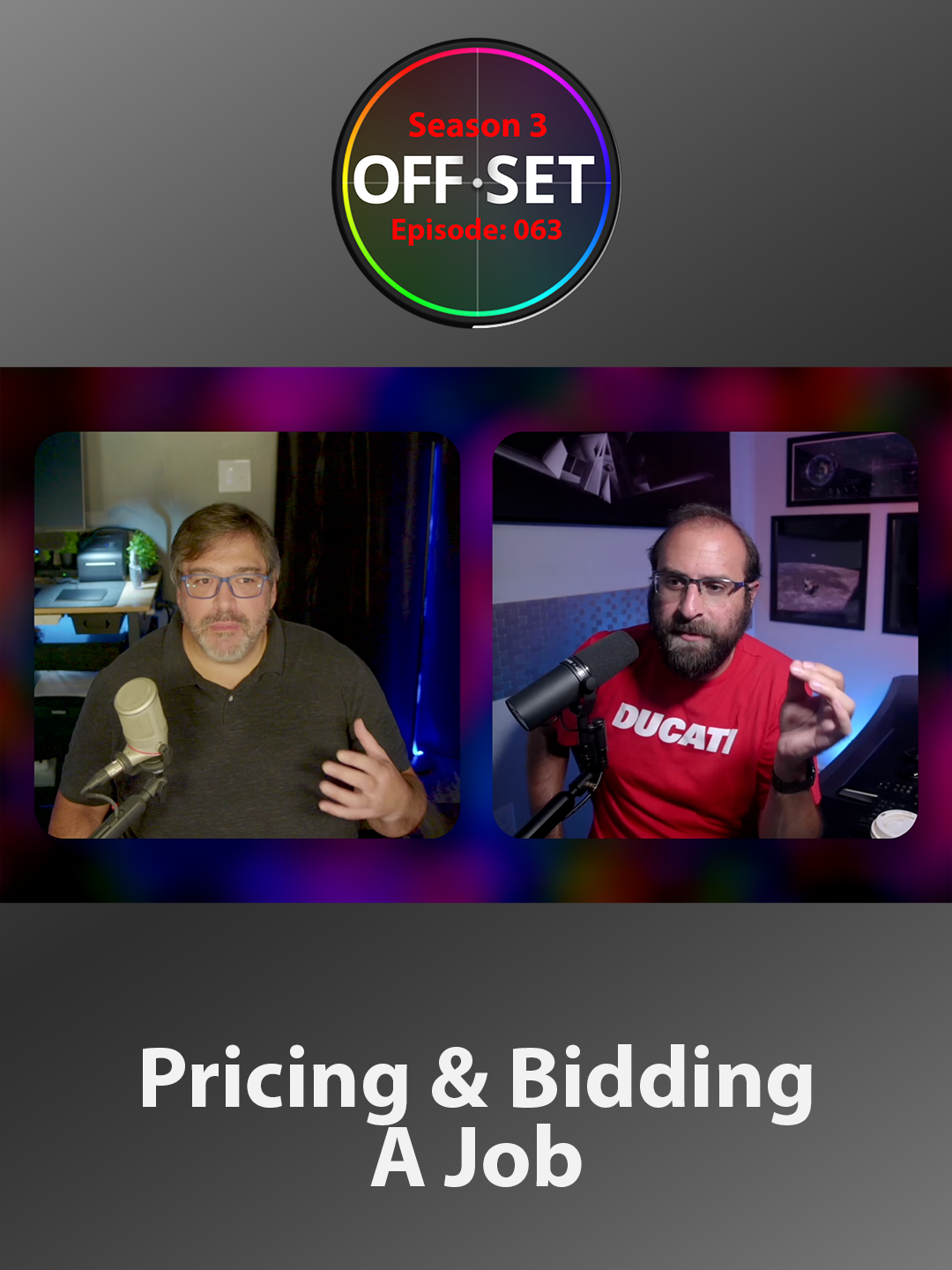
EP063: Pricing & Bidding A Job
Pricing & building proposals doesn’t have to be hard
In this episode of The Offset Podcast we’re discussing how to determine your rate(s) and bid on a project.
Pricing, discounts, and proposals are challenging for many people – and lets face it – these topics while are important, are decidedly not the fun part of running a postproduction business.
In this show, we’ll explore how we go about thinking about setting rates, building proposals, handling discounts and more. Some of the specific topics we discuss include:
- How your market, experience, overhead and perceptual goals all influence determining rates
- Picking a rate type – hourly, day or flat
- The importance of scoping to flat rates + having ‘special’ rates for evening and weekend work
- Building a rate card
- Building a project order/proposal & handling discounts
- Consistency in pricing
If you enjoy the topics and discussion of The Offset Podcast you can join in the conversation with our new Discord community
You can also follow us on Instagram & Facebook – just search for The Offset Podcast.
Be sure to like and subscribe to the podcast wherever you found it and be sure to check out our growing library of episodes. If you like the podcast it’d mean the world to us if you’d consider supporting the show by buying us a cup of virtual coffee –https://buymeacoffee.com/theoffsetpodcast
See you again in about two weeks for a new episode!
Video
Transcript
00:00:00:00 - 00:00:14:09
Robbie
Hey, everybody. Welcome back to another episode of The Offset Podcast. And this week we're taking a look at the mechanics of pricing a job. Stay tuned.
00:00:14:11 - 00:00:47:06
Joey
Support for this episode comes from Flanders Scientific and Gaia Color Auto Cal and Analyzer. Accurate calibration and routine verification are critical in our industry, and Gaia Color makes the calibration process both fast and convenient. Available across supported DM, XMP, and XMP C series monitors, Gaia Color allows a wide range of compatible measurement probes to connect directly to the monitor for automated calibration and objective performance verification without an external computer or calibration software.
00:00:47:08 - 00:00:51:21
Joey
Learn more at FlandersScientific.com
00:00:51:23 - 00:01:00:03
Robbie
All right everybody, welcome back to another installment of The Offset Podcast. I'm one of your hosts, Robbie Carman. With me is Joey D’Anna Hey, Joey. How are you, buddy?
00:01:00:04 - 00:01:01:21
Joey
Hey, everyone.
00:01:01:22 - 00:01:36:02
Robbie
Episode 63 Joey. And, this is one that I've been meaning to talk about for a while. We've skirted around the edges of this in various episodes a little bit, but that is kind of the mechanics of how do you actually price a job, right? Like we've talked about, you know, communication with clients, we've talked about other business topics, but we've never really explored the exact mechanics of figuring out, you know, rate how you put that rate into a, you know, a digestible document for a client, how, you know, you do things like discounts, all that kind of stuff.
00:01:36:02 - 00:01:40:05
Robbie
And so we figured, hey, we'll take a stab at it. Now, I want to be clear
00:01:40:05 - 00:01:47:11
Joey
And it’s a tough question because, like, we don't build houses, we don't fix cars, we don't have parts, we don't have.
00:01:47:13 - 00:01:58:11
Joey
You know, input pricing. You know, we don't I have to buy lumber for this job that has a fixed cost. You know, there's so many variables that apply to pricing a color job that are really intangible.
00:01:58:12 - 00:02:17:09
Robbie
Absolutely. That there's there's no like, commodity. It's all service. It's, you know, sort of a certain degree it's fungible. And we're yeah, we're going to talk about that. And I want to be honest about something that this is a subject I think we've largely avoided just because we don't really want to like, dictate to somebody like, hey, you should be setting your price at this or setting your price at that.
00:02:17:09 - 00:02:35:18
Robbie
So one of the things that is sort of going to be a theme of this is this is kind of the way that we do it and think about it. But the big overarching thing here is that one size does not fit all. Obviously, anything that we talk about in this episode, the particulars of your situation, your market, your clients, those are all going to come into play.
00:02:35:18 - 00:02:58:01
Robbie
So don't as you listen or watch this episode, don't feel like this is like a dogmatic approach. We're going to try to make things more, you know, conceptual, higher level about pricing and bidding out a job. Obviously, your particulars are always going to matter. All right. So before we begin, a couple of things, housekeeping things, as always, you can always head over to Offset podcast.com to check out our complete library of episodes.
00:02:58:01 - 00:03:18:08
Robbie
This is episode number 63. Who time is time is flying by. You can also follow us on Instagram and Facebook. Just search for The Offset Podcast and you can follow us there. That's where we do things like episode announcements and stuff like that. As we mentioned in our previous episodes, we have just launched our Discord community for the show.
00:03:18:10 - 00:03:34:13
Robbie
You can find that link right here on screen. It's an open Discord. Feel free to join us over there. Plenty of fun conversations going on. I think we're up to 70 or 80 members so far, something like that. So feel free to join the discord. It's always good to have some people, you know, some new faces in the conversation.
00:03:34:15 - 00:03:52:03
Robbie
And then last thing is, we'd really love it. If you'd consider supporting the show, you can visit this link right here on screen to buy us a cup of virtual coffee. Every dollar donated goes right to supporting the show, helping us with our overhead and all that kind of stuff to get these episodes out every two weeks. All right, let's dive in, man.
00:03:52:05 - 00:04:12:20
Robbie
I think the first thing, as I said, one size doesn't fit all. And I think when it comes to figuring out your rate, I think one of the most important things, probably the most important thing is the market that you're in, right? You know, if you're in, you know, rural Idaho, that's a different market than, say, Manhattan, right?
00:04:12:21 - 00:04:35:00
Robbie
And that that that market also drives expectation. Right. But it's a little like the weird thing about market is also it's a little bit, it's a little bit weird and sort of inverse. Right. You would think that like, hey LA, it's the heart of postproduction. Everybody should be charging $1,000. But then market also plays in with saturation.
00:04:35:01 - 00:04:45:19
Robbie
Like let's talk about that a little bit because market is an interesting thing to build your numbers around because yes, it matters. But it's also kind of inversely weird sometimes.
00:04:45:21 - 00:05:01:14
Joey
Yeah. And you know, the weird thing about looking at your market, whether that be, you know, market doesn't have to only be location, right. Especially now there's so much remote work out there. Market could be your circle of clients, the people.
00:05:01:14 - 00:05:04:18
Joey
You've worked with. Right.
00:05:04:20 - 00:05:37:08
Joey
Yeah. You specialize in. But in reality it's kind of a combination. It's where you live and work, the clients you work with, the rows and the the workflows that you do, all of those kind of push and pull on each other to, to make this amorphous blob of what is the market you're in. And then every other factor, we're going to talk about your experience, your overhead costs, your clients budgets, all of those kind of it's almost your market is almost like a multiplier adjustment to that.
00:05:37:09 - 00:05:57:19
Joey
Right. So like a colorist of huge experience, it charges high rates is going to be different in certain markets or in certain sets of clients etc.. But it's still going to be proportional. So it's kind of like the market is kind of like a proportional adjustment to every other factor involved in your pricing, right?
00:05:57:19 - 00:06:13:01
Robbie
If you are a colorist in a major metropolitan area with lots of overhead, your market rate might be different in, again, a small rural town, because guess what? Rents not $1,000 a square foot. It's, you know, $20 a square foot.
00:06:13:02 - 00:06:26:01
Joey
But the ratio between like your rate in Manhattan and then your rate in rural wherever between you and somebody who is junior and less experienced, that ratio is probably going to stay around the same. Yeah, true.
00:06:26:01 - 00:06:35:21
Robbie
And I think one of the ways of kind of inquiring about market is just to have conversations with people. Right. Asking colleagues and peers, okay, what are you charging for this? What's your kind of rate.
00:06:35:22 - 00:06:38:04
Joey
And people are much more open about that these days.
00:06:38:05 - 00:06:38:19
Robbie
Than they used to be.
00:06:38:20 - 00:06:40:01
Joey
For sure. Probably a good thing.
00:06:40:02 - 00:07:04:21
Robbie
And I'm not I'm not suggesting that anybody do things that that are nefarious like you. No. Call a major facility and go, hey, I have a fake project. Can you give me a bid so I can pull? I mean, I mean, that that stuff does happen, of course, but I'm just saying asking around and getting an idea of what the general market supports is a great first step to figuring out what your rates should be, how people more than just the number.
00:07:04:23 - 00:07:25:05
Robbie
Also sort of the mechanics of it. Yeah, you'll get an idea. Okay. Most of the facilities are charging hourly rates or most of the facilities are charging, you know, flat project rates. It will give you an idea of what's what. Right. The other thing you just hinted on, I think is a big determining factor. And it's germane, I think, to a lot of our listeners, is the idea of experience.
00:07:25:06 - 00:07:48:04
Robbie
Right. I think that there is certainly a people with large bodies of work, lots of experience, just kind of, by definition, have a little bit more leeway in charging higher rates. But this one, I'm going to push back a little bit on, because I think that the newbie colorist, the neophyte colorist or editor or whatever getting the post-production goes, I'm new.
00:07:48:05 - 00:08:05:00
Robbie
I can't charge as much as I as somebody, you know, with a lot of experience, I get it. It's a certain amount of logic, but also go back to the market part, like if you if your market is charging, let's just pull a number out of a hat, $200 an hour for something and you're like, hey, I'm a new colorist.
00:08:05:00 - 00:08:24:19
Robbie
I'm going to charge $100 an hour. You're not serving your market well, right? Because now all you've done is chop the legs out from the market, even though you might be new. Yes, I get that. You don't feel like you can charge as much like that is a it's a it's a very sensitive thing. Right. Because you don't think you're worth that much.
00:08:24:19 - 00:08:29:17
Robbie
But at the same time, just by charging less, you might be doing damage to your market too.
00:08:29:21 - 00:08:52:21
Joey
And as a result too, as you develop and as you get better and you get higher end clients and stuff like that, it's going to be harder and harder to kind of raise your rate up to be contemporary with the market. So there is definitely if you are junior and you don't think you can compete with somebody who's much more senior charging a particular rate, by all means, adjust downward.
00:08:52:22 - 00:09:21:12
Joey
But don't overdo it right. Don't come in so low that you're just like looked at as the cheap option. You never want to be looked at as the cheap option. You want to be looked at as value to the client. Whatever you bill, whatever you're charging, you want your client to think they're getting value for that money. And if you're under bidding so much to get jobs and get experience, your clients are only ever going to look at you as well.
00:09:21:14 - 00:09:30:09
Joey
We don't have a lot of money for this one, so we're going to send it to the cheap guy. Yeah. Yeah, exactly. Later on where we have more money, we're not going to send it to him because he's the cheap guy, right?
00:09:30:09 - 00:09:59:19
Robbie
I mean, I see people on, you know, Reddit and other places going lamenting the fact that they're not getting, you know, Netflix or Amazon jobs or whatever. And like, you know, then they're like, oh, but I'm charging, you know, $85 an hour. And it's kind of like, well, you know, maybe the reason you're not getting that is because those people who are the string pullers, that those those productions are going, what, $85 an hour like, no, that's too good to be true.
00:09:59:21 - 00:10:21:14
Robbie
Like, it can't happen, you know. And so that leads me to my next part about this is a perceptual thing. And I think this is something that you cannot underestimate. But I will admit it is a slippery slope. It's very tricky to get right. And that is I think largely rates are determined by who you want to be in the sort of in the market perception.
00:10:21:15 - 00:10:52:20
Robbie
Right? If you go out and go, hey, I'm kind of riffing on what you just said. I'm charging $1,000 an hour perceptually. That's a much different feel than somebody charging $100 an hour, right? If I'm somebody charging $1,000 an hour. Like, are they that good? What do I get for that extra thousand dollars? And I think there's a balance in sort of doing that, because clearly charging more in that perceptual message that that sends gives you a little bit more gravitas in the conversation.
00:10:52:20 - 00:11:14:13
Robbie
But it also raises the expectations, right. If you're charging a lot of money per hour. Yeah. You sure as hell might not. You can't be going, hey, what's drop frame timecode again? Or I've never heard of SRT files. Like, if you start doing stuff like that and you're charging $1,000 an hour. Well guess what? Like that perception can fall, you know, smack you back in the face.
00:11:14:13 - 00:11:33:20
Robbie
To the other part about the setting. The rate to I think is complicated, but I'm going to just real quick mention it is that is, you know, I think if you go to a business school and you talk about, margins and all that kind of stuff, you know, one of the things they're going to say is like, well, you have to know your overhead, right?
00:11:33:22 - 00:11:58:06
Robbie
And I think this is one place where a lot of people, us included from time to time. Don't do the necessary work to figure out exactly what the overhead is. The margins are right. If you you know, if it costs you $300 an hour to operate. Right, and then you're charging $300 an hour. Guess what? You're breaking even, right?
00:11:58:10 - 00:12:16:14
Robbie
Right. So you have to figure that part out. And I don't think it should be the only determining factor. But if you have, you know, if you have relatively healthy margins, that's how you make money. If you don't have healthy margins, you're just kind of robbing Peter to pay Paul kind of thing, right? It's just sort of breaking even.
00:12:16:16 - 00:12:41:22
Robbie
And so one of the other aspects I would really encourage people to do is figure out exactly what that monthly number is, and exactly how many hours or days or whatever the demarcation is, that you need to break even and then build off of that. Right. Because nobody wants to break even. You want to be making. You know, in this game, the potential is, you know, 20, 30, 40, 50% or more work that work that in wherever you can.
00:12:42:00 - 00:13:02:05
Joey
Yeah. And you know that that expense ratio is not just your monthly bills, right? It's I bought X amount of dollars of equipment this year. I bought this much supplies. You know, back in the day it used to be things like tape. We don't think we don't have to buy tape anymore. But I bought a bunch of hard drives and I sent them out to clients.
00:13:02:05 - 00:13:23:00
Joey
I only got half of them back. You know, that's a that's a very common loss rate thing that happens is and you just got to accept it in some cases you might not ever get that back. You know, I just bought the biggest, baddest computer that's going to last me three, 4 or 5 years. So what does that computers cost divided over those five years.
00:13:23:00 - 00:13:25:05
Joey
What is that. Yeah, mean.
00:13:25:07 - 00:13:42:16
Robbie
And those ROI calculations are complicated. There's a lot of opinion on the value of some of them. This, you know, one way of looking at it, another way of looking at it, I think you can really get in the accounting and analytical weeds about this. That's not really where, you know.
00:13:42:18 - 00:13:44:15
Joey
You got to be generally aware.
00:13:44:17 - 00:14:07:04
Robbie
My point is more like elevator pitch level kind of awareness, right? If somebody goes, hey, what is your monthly number? You can just go, oh, it's about X, right? I'm not saying you have to get down to the penny, but knowing that you have to make a certain amount of money to cover your bills and make that profit margin, I think, is a key component of how you go into determining your rate as well.
00:14:07:06 - 00:14:31:11
Joey
Yeah. And it's also how you go about determining what we want to talk about next, which is how do you actually bill for a job, whether it be hourly, day rate, flat rate, those all have advantages and disadvantages, both from the client side, your side, all of the different aspects. If you know what, what and when your expenses are, you can be better informed to decide what you can offer the client in terms of terms.
00:14:31:13 - 00:14:57:22
Robbie
Yeah. And now these these these types of rate. Right. As you said hourly, daily and, you know, flat rate or whatever. I think the first thing you need to know is that this is also has a huge market influence, right. If, if everybody in your market is going, hey, we just do it for a flat rate and like you all of a sudden come out of the gate, be like, no, I do everything hourly is a little bit of a disruptor, not only to the client, the client pool, but also to your market in general.
00:14:57:23 - 00:15:12:13
Robbie
Right. And so I think that's one thing you have to consider about this, but let's talk about each one of them because I think you're right. They do have pros and cons. And I think if you talk to anybody in this business long who has been in it long enough, the one thing, though, almost always say is, yeah, I realize the right way to go.
00:15:12:14 - 00:15:19:11
Robbie
Why is that, Joey? And what are the in your opinion, what are the pros and cons of an hourly rate?
00:15:19:12 - 00:15:50:18
Joey
Because one is the most direct correlation to how much work you're putting in. Like we said, we don't have material costs. So your hours are the direct like representation of your effort put into this project. In most cases when you bill hourly, you're going to make the most money. Are in some cases that's not true. But in a lot of cases, if you're billing hourly, you are adding and adding and adding every minute you're working.
00:15:50:23 - 00:16:17:11
Joey
And that total number just keeps going up. So if you have enough clients that are happy paying hourly to fill you eight hours a day. Wonderful. That's great. Where some of these other things come into play is most colorists, unless they're working at a facility, don't have a. I am scheduled every day, eight hours a day on various projects that are billing hourly.
00:16:17:12 - 00:16:42:21
Joey
Right. The independent color doesn't usually have that. I'm working on maybe two projects today, and I got a short form thing that came in while I'm in the middle of this film, you know, and you're juggling and managing your time accordingly. That's where I think the not so much the day rate, because just to talk about day rates for a moment, day rates are almost always if you are freelancing at a facility, right.
00:16:43:03 - 00:16:53:03
Joey
An independent color is just not offering a charge a day rate, because they're never going to dedicate their whole day to a single client. If they are, they could just be hourly.
00:16:53:04 - 00:17:12:06
Joey
A day rate is a good way of one. Getting consistent billing. If you are working for a facility and knowing exactly what you're. I booked two weeks at this facility at this day rate. I know at the end of those two weeks exactly how much money I'm going to come out of the door with great facility. It's very predictable for them.
00:17:12:06 - 00:17:16:23
Joey
It's very predictable for you. That's kind of that's why that works.
00:17:17:01 - 00:17:40:05
Robbie
Well. And also I'd add to that too. It's also kind of like industry subsets kind of specific to like where, you know, I think the the nomenclature is like if you're hiring crew for a production, right, you're hiring a DIT or a, you know, an AC or something, like it's just kind of standard that that's built out as like a day rate, right, where that's kind of become the norm.
00:17:40:07 - 00:18:02:17
Robbie
I agree with you that day rates in particular are a little weird in post-production facility work. But if you are a freelancer and I mean by that, like if you're, you know what you're charging the client, but if you're a freelancer going, you're going to do overflow or go work at a facility. Yeah. Day rates make sense. Support for this episode comes from Conform.Tools
00:18:02:19 - 00:18:30:10
Robbie
Conform.Tools converts timelines between Premiere, Media Composer, Resolve and other NLEs. Automatically handling what you'd normally fix by hand. Things like speed ramps, keyframes, repositions, and even Sapphire effects. And when it's time to move media send massive projects to collaborators in minutes instead of hours. Conform.Tools only transfers the media your timeline actually uses without you even needing to trim or consolidate media.
00:18:30:10 - 00:18:51:03
Robbie
Built by post professionals Conform.Tools helps editors, colorists and conform artists move faster and finish stronger. Let it handle the tedious stuff so you can focus on the creative. Start a free seven day trial at Conform.Tools. I want to mention one thing about the hourly rate that I think is that I think is important.
00:18:51:03 - 00:19:15:07
Robbie
Is that one hourly rate, like it has levels of enforcement to it. And what I mean by that is that, you know, we tend to charge things when we can charge things hourly, like short form work or whatever, but it's not like we are hard tracking those hours, like, I mean, you know what I'm saying? Like at a certain degree we go, hey, how many hours is that?
00:19:15:08 - 00:19:37:06
Robbie
Yeah, it was two. It was three, right? The strictest interpretation of an hourly rate is there's a time clock, right? You sit down at your desk in the morning and you are tracking every minute of every day. And you know, whether you decide that that's a quarterly, a quarterly, an hour or a half an hour or you only charge for full hours, whatever it may be.
00:19:37:08 - 00:20:00:07
Robbie
You know, that's a strict interpretation of that. And the downside of that is clients will not like working with you if you're not, even if you're remotely slow. Right? Because it's like, hey, I brought you with three seconds job. You're a 32nd, a three seconds job, a 32nd spot. And, you know, this took you seven hours to do, like.
00:20:00:08 - 00:20:01:18
Joey
Yeah, that's never going to fly.
00:20:01:20 - 00:20:27:03
Robbie
Like, that's never that's never going to fly. So it is a little hourly. The one thing that we're, you know, concerned about is that if you're trying to get a true, accurate representation of your hours, it can be difficult to do because there's going to be pushback on speed and efficiency from clients. Right. Very rarely are you going to the client who goes, whatever it takes, no matter how long it takes.
00:20:27:03 - 00:20:50:18
Robbie
That would be the perfect hourly situation. But more times than not, the hourly situation is fungible, right? Oh, it feels like three hours. It feels like four hours because almost nobody is doing that level of, you know, they're not billing like a lawyer, right? I guess what, it would be a good analogy where it's like, hey, every five seconds I pick up the phone or an email, it's billable, it's billable, it's billable because the clients don't have time for that.
00:20:50:18 - 00:21:08:00
Robbie
So that goes into what I think you were saying about, yeah, day rate is not really a thing for a lot of postproduction. You know, companies. It is more for a freelancer kind of thing, but gets us to the idea of a flat rate. Right. And I think that flat rates are an interesting thing for certain types of work in our industry.
00:21:08:06 - 00:21:32:15
Robbie
I think we're flat really works is for projects who want, who need to control costs or have tightly controlled, limited budgets. Right. You know, client says, I have six grand for this film or whatever it is, you know, and you can say, sure, I can work within that six grand. But the thing that's, I think a dirty little secret about flat rates is that they're not really any different than an hourly rates.
00:21:32:15 - 00:21:58:00
Robbie
You're just estimating how many hours you're going to put into that job. And so when you put out a flat rate and unlike the streaming clock of an hourly flat, rates are really tricky thing if you don't have the experience on estimating what a project is going to take in a ballpark hourly rate, you estimate something you're like, oh yeah, sure, it's two hours and it's really 20 hours.
00:21:58:06 - 00:22:02:01
Robbie
Well, you just flat bid that way under and now you're screwed.
00:22:02:03 - 00:22:24:20
Joey
Yeah. And what I think is really important, no matter how you're billing, at the end of the day, you've got to think about the hourly rate that it's resulting from, right? If you are bidding a film like an hour long, like an hour long doc and you're saying it's going to be X number of dollars, you need to whether you, you know, show this to the client or not, you know, you need to know exactly how much at what you want your hourly rate to be.
00:22:24:23 - 00:22:55:16
Joey
That equates to that way you have some general concept as to how much effort and time is going to go into this project before you get started, so you can manage your expectations and manage your time correctly. Now, it's great from the client's perspective, because it means they're not going to get surprises at the end. Sometimes for us, the flat rate works great because maybe we get through something quicker than we thought, and it ends up we make more money for the net amount of hours we put into it.
00:22:55:17 - 00:23:15:14
Joey
Sometimes it goes the other way, sometimes to get it to the level we need it to be. We need to put in a few extra hours beyond what we told them it would be. At that point, you're still within the ballpark of where you wanted to be price wise, but you have a very happy client because they got a great product and they didn't have any budget surprises.
00:23:15:16 - 00:23:34:22
Robbie
Yeah, I agree, and I think that one of the things that you have to understand about flat rates, and I think we're a lot of new people in the post-production get themselves in trouble, is that they don't have the experience of one asking a full set of scoping questions. Right? So they don't they they get surprised when. What do you mean?
00:23:34:22 - 00:23:42:15
Robbie
You told me you can do this for five grand. Oh, I'm pretty sure we mentioned that there would be 300 blurs you have to do in the show. And you're like, oh yeah.
00:23:42:17 - 00:23:45:10
Joey
And DCP. And the version.
00:23:45:11 - 00:24:14:05
Robbie
All of the. So like part of it is the experience in asking the right questions when you deliver the bids. So, you know, sort of the wholeness of the project. Right. The other problem with that is that even if you're flat bidding, that doesn't necessarily mean that there are costs that you have to eat, right? For example, if you need to send a drive to a client, right, you shouldn't be required to eat the cost of that drive, eat the cost of shipping.
00:24:14:05 - 00:24:29:06
Robbie
And we'll talk about this in a minute. When we talk about actually building out, you know, sort of a proper proposal or a project order. But that's one thing where I see a lot of people getting screwed on is that, wait a minute, why did you charge me for, you know, 30 bucks for shipping? Well, because I had to send you back the drive, right?
00:24:29:07 - 00:24:52:01
Robbie
Like those things should be known, quantified ahead of time and considered sort of extras to the flat bid because plenty of people will go, oh, I didn't expect this cost. Well, you know, you got to pay for it somehow from the client side of things. One more thing I want to say about hourly versus flat, especially for our our side of things, for the color things I tend to find.
00:24:52:01 - 00:25:20:05
Robbie
I think you would agree with this, that hourly rates are much more doable, consumable by clients on short form work, right? Yes. When you're doing a doing a spot or a promo, hey, it's three hours to do this promo or whatever, or it's, you know, an hour to do the spot where as long form work, like a series or even a movie, you know, they're working with, we have X amount of money we have to keep within this budget.
00:25:20:05 - 00:25:25:09
Robbie
This can't change. That's much more, I think, where we find flat bids on projects happening.
00:25:25:11 - 00:25:47:00
Joey
And that goes hand in hand with the other major, what I think is the other major component in determining a flat bid cost, which is deadlines and timetables, hourly rate, the deadline of the timetable doesn't really impact your rate because you're doing the hours at the time it needs to be done again. Mostly short form. Got a spot today?
00:25:47:02 - 00:26:07:17
Joey
Here's your spot. We're done in our bill. The hours. It's simple. We've got a series coming up with ten episodes. We want you a flat bid for every episode. How many days do I have to do that episode? How far in advance are you going to give me materials? How far between approval steps? Between when I send you a screener?
00:26:07:17 - 00:26:34:15
Joey
Are you going to get me notes? What is the deadline that I need to deliver this by? All of those can dramatically impact how flexible you can be bidding out that flat rate, which is a you know, once you kind of get the art of scheduling in your head down a little bit where you like. Yeah. Oh, I can do a little bit of extra work on the weekend to move things ahead so I can have an easy week, because I'm building this flat and I have two weeks to do it.
00:26:34:15 - 00:27:01:15
Joey
You can kind of manage your time internally in a way that what might be a slightly lower flat bid is still very profitable and very ideal for you. And again, you leave with a happy client, right? But as they always say, you can have good, fast or cheap, you get to pick two. And in my world, I think in any colorist world, not good should already be off the table.
00:27:01:15 - 00:27:22:09
Joey
You don't want to do jobs badly, you know you don't want to. Client doesn't have enough money. So I'm going to do a shitty job on this one. We don't ever want to be in that role. So your variables are expense, cost and time. And it's very hard to manipulate time on a day rate or an hourly rate.
00:27:22:10 - 00:27:29:21
Joey
But you can definitely manipulate time and use it to your advantage on a flat rate, on a longer form, longer term project.
00:27:29:23 - 00:27:58:22
Robbie
Now, you said something, and it's an important thing that I think in the flat rate discussion is, and I'll just use the word fungibility. You said flexibility of time, whatever. But like it really is a fungible thing. However, however, part of the problem is, is that if you find yourself funding things too much, that is an indication that you have not done the proper work to initially properly scope and flat bid that project right.
00:27:58:23 - 00:28:27:10
Robbie
And the problem with that is that you come to resent the work, resent the client, resent the gigs because of a mistake that you made. And one place that that is so perfectly clear to me is when it comes to evening and weekend work, right? Like we are so hungry, especially in the day, like the current, you know, environment of the post industry, so hungry for work that we tend to go the extra mile for people.
00:28:27:11 - 00:28:55:02
Robbie
Just because I get that and it's important, it's an important thing to recognize. But at the same time, I think there are other rates to consider that will make you, if you can factor in. Right. So you could do a flat rate, but say, hey, if something in your project demands weekend work, right? That is a special case scenario and will be billed so above and beyond and separately at this rate, right?
00:28:55:03 - 00:29:17:20
Robbie
Because if you just flat rate things, there's a certain subset of people and we all probably know them or have worked with them, that goes cool. You gave me a flat number. I am going to destroy you now with with work and requests. Right. And so you just need to set up some guardrails of that. And one of that things, one one things that I'm protective of is no, I need that evening time, I need that weekend time.
00:29:17:20 - 00:29:35:02
Robbie
So if you really need that Mr. Client, guess what? You're going to pay for the privilege. And that's not included in what I'm I'm estimating normal, you know, 9 to 5, 9 to 6 kind of work day. I'm not talking about, you know, having to do a deliverable on a Sunday. Right. And so and.
00:29:35:02 - 00:29:40:06
Joey
That's not to say you can't move your schedule around internally to best fit you.
00:29:40:08 - 00:29:57:04
Robbie
Yeah. If it makes you feel better, if it makes you feel like you're getting the hell you know, hey, my family is doing something. Running some errands on this Saturday afternoon. I got an extra 2 or 3 hours and you, you know, push the ball forward doing a conform or whatever. Fine. That's just your own sensibility of wanting to get ahead of it.
00:29:57:05 - 00:30:15:11
Robbie
What I'm talking about is doing things on demand at off hours for clients because they're asking for it. That's where your flags should go up and go, no, this is not the normal part of my my flat rate or or whatever. Or if it's hourly, it's a special type of hourly. And I think you need to spell that out.
00:30:15:13 - 00:30:37:03
Robbie
So one thing I'm often surprised about, Joey, and, you know, this is like over the years, this has kind of become a little bit of a meme. And in its own self, the idea of building like a rate card. Right? And I think if you go to like large facilities, you know, the, the modus operandi there is like, hey, revenue streams.
00:30:37:07 - 00:31:20:00
Robbie
Right? We need to, you know, hey, you're uploading revenue stream, downloading revenue stream, lunch revenue stream, whatever it may be. Right? And those rate cards can get really long and thick and detailed. I think for the average operator in our industry, they have not spent enough time looking at that menu for their own work. Right. And this is a it's a hard thing to judge because at one hand you don't want a nickel and dime people, but there's it's likely that you're also doing things for free or, or putting it under the umbrella of your, of your rate that you probably could be charging for.
00:31:20:02 - 00:31:41:10
Robbie
Right. And I think that that's, it's, it's some work that I think us included need to do some reevaluation probably of on a, you know, on a yearly basis. Go, hey, what is our rate card look like? Not only in the actual numbers, but what we are actually charging for, right. And, you know, our rate card internally is rather simple.
00:31:41:12 - 00:31:58:12
Robbie
Arguably it could get a little bit more complicated. But you know what I'm saying? Like, I think there's a lot of services that just because we're nice guys and we want to, you know, get clients to, you know, be repeat customers and like us, you know, we do the extra mile sometimes and I think we're leaving some money on the table potentially.
00:31:58:13 - 00:32:24:16
Joey
Yeah. I mean but it becomes a balance because it does, like we said before, kind of figuring out that that net hourly rate is so important. It might serve you better in your market with your clients to incorporate all of those little things that you could build separately into just an overall higher hourly rate. And if the client, because the client doesn't want to see a million different things on any invoice, they just want one number.
00:32:24:18 - 00:32:31:19
Joey
You know, that's one of those things you just got to be aware of as and and that might change client to client too. Yeah.
00:32:31:21 - 00:32:51:02
Robbie
It's true. I mean and the other thing too, I think that is is a good test marker for this. Is that like if you're doing things like okay, fine, you do a spot, you upload it to frame IO, whatever. Like it kind of seems petty to be like, hey, I'm charging you, you know, $5 for that upload or whatever, right?
00:32:51:06 - 00:33:15:22
Robbie
But if you're doing something where you're like, oh, I'm moving 50TB to an S3 server for a network, well, that's a different that's a different set of calculus altogether, right? Like that's a real service, real time suck. And more importantly, it's, you know, occupying your bandwidth, you know, mentally, physically, but also your internet bandwidth, like, that feels like a service you probably should charge for.
00:33:15:22 - 00:33:32:21
Robbie
Right? So I think it's you're right. It is a little bit of a case by case basis. But my point overall, point being, I think there's a lot of things that could be on a rate card. And even just the the idea of documenting them helps you out later on. When you're scoping things, you can make the decision.
00:33:32:23 - 00:33:41:05
Robbie
Am I going to put that thing on this proposal, or am I going to just, you know, add another hour of regular time? At least you have that flexibility at that point.
00:33:41:05 - 00:34:02:01
Joey
Yeah, because if you're bidding out a flat rate, if you don't know all the little details that go into that project, you know, it's harder to do that flat rate. If you look at the last one and you say, oh, well, I had to spend two days uploading or organizing files or setting up deliveries on a client portal where you have to fill in a thousand different metadata fields by hand.
00:34:02:05 - 00:34:09:14
Joey
You know, all of those impact your overall time. That should go into the scope of your flat bid.
00:34:09:16 - 00:34:25:20
Robbie
Yeah, and it's one of those things that every time you do this kind of things, you need to make some sort of mental note or a physical note of like, oh, this type of project has this kind of requirement usually, and I haven't been charging for this, and I need to next time this happens, I need to make a case that I charge for.
00:34:25:21 - 00:34:54:15
Robbie
Right? Because again, it's more about ending up presenting the things that you're not charging for, and you feel like you're losing money on the table. Now, all of that to me. Joey culminates in the idea of putting together an actual document that you put in front of a client. I have to just say it. I am, and this is a this is strong language for this, but I'm disgusted by how many people get taken advantage of by not documenting putting things on paper.
00:34:54:19 - 00:35:02:22
Robbie
I thought we or didn't we? You know, those are not places that you want to be when you're talking about scope of work and money.
00:35:02:22 - 00:35:15:18
Joey
And I'm the worst at it. Like, yeah, sure, we can do that. Cool. I love getting clients and work. I'm going to be a nice guy. I'm so bad at it. Sometimes you need to be the bad guy and put it all on paper.
00:35:15:20 - 00:35:35:23
Robbie
Yeah, and it's hard. It is. It is a hard thing to to be firm with this stuff when you're a solo operator because, you know, it's a weird conversation, right? You're doing something awesomely creative and artistic or whatever, and then you're turning to that same person a minute later and go, hey, about that pass invoice or, you know, or about that, you know, that new project that you want to discount on, right?
00:35:36:00 - 00:35:59:08
Robbie
It's a little weird. You know, in our dynamic, you know, we both do this for each other a little bit. It's like the idea of good cop, bad cop, right. And I think that that is an important thing to have as you grow is sort of understanding, like, no, when Joey's on a big project on a film, I'm happy to play bad cop because I want him to be focused solely, solely on the artistic and creative portions of this.
00:35:59:08 - 00:36:15:20
Robbie
I'll play bad cop. He'll do the same for me in the reverse, that scenario. And that's one thing to think about. But more to the point, is building a proper proposal or project order, I think is key, because not only does it spell out things like, hey, here's the specifications of the project, this is what we're doing for you, right?
00:36:15:23 - 00:36:45:13
Robbie
It spells out things like an agreed upon schedule, obviously agreed upon costs. But it also covers things like, you know, the terms and the things that you're allowed to like, hey, am I allowed to use this footage for my Instagram or not? Right. If I am, how long do I have to wait? So like, there's sort of, I think two things that kind of I'm lumping together, but I think they're important to kind of differentiate to sort of the project order or project proposal and then kind of like terms of services.
00:36:45:14 - 00:37:19:18
Robbie
Right. And like those two things can often be in one document. Some people separate them out, but they're both things that I think that people should think about. And, I'm just I'm not ready to fully roll this out, but I will just sort of self-serving say, I think about this all the time, and I've actually built a piece of software to allow people to do this that I'll talk about in a future episode, but it is a it is a service that I'm about ready to roll out exactly for this, for scoping, because I think it's something that I see the industry not doing enough of, especially at the lower levels, and it can
00:37:19:18 - 00:37:22:03
Robbie
come back and bite you for it can bite it hard to.
00:37:22:04 - 00:37:44:16
Joey
And it's one of those things where it's like, yes, it can be a hassle. It's extra work to do all these documents and figure it all out and write it all down, when sometimes you just want to, you know, get the job in front of you. Start impressing your client. Right. It's worth taking the time. And like I said, I was always the worst at this, and it bit me multiple times.
00:37:44:18 - 00:37:44:22
Joey
Yeah.
00:37:44:23 - 00:38:04:20
Robbie
I mean, the thing that the fact of the matter is that if it's not documented, it didn't happen, right? It's a he said, she said thing. It's a it's just a word of mouth. Like it can get written like the way that I think about proposals, terms of service, that kind of stuff is not for when things are going swimmingly with you in the client.
00:38:04:21 - 00:38:24:11
Robbie
It's when and it happens. It's just a fact of life when things are not going well and you need something to point back to and go, wait a second, you agreed to this. Whether that agreement be schedule, cost, deliverables, whatever it be, right that you have something to point back to and go, no, no, no no no no, you you agreed to this.
00:38:24:11 - 00:38:48:07
Robbie
This is the truth of what our working relationship and this is what happened. And I think that, you know, the other part about that, you mentioned, like the time part about doing it, but there's also this perceptual part of things. Right? Think about it. If you were hiring a contractor to come to your house, right. One of the things that you would probably be put off by if a guy is like, yeah, man, I work on the air conditioners.
00:38:48:09 - 00:39:08:08
Robbie
Okay. Like, that's I'm just going to take your word for it. No. You want to see, like, hey, here's a breakdown of parts and services. This is our rates. This is our refund policy. This is our warranty, right? You're probably not going to hire that home contractor with just some dude, you know, who's just like, yeah, I can do it, right.
00:39:08:08 - 00:39:31:09
Robbie
You want. So there's a perceptual part about this. When you do this work, you're taking a little bit more seriously about valuing your time, your business, your contractor contractual obligations. Right now, one of the things that does happen from time to time is that you'll get client feedback on proposals and projects, let's put it that way. Right? People go, are you crazy?
00:39:31:09 - 00:39:51:01
Robbie
You're going to charge this much? What happens at that point like is is is a proposal the final word? You know, I don't think so. But like, how do we how do we go about handling that when a client goes, hey, this cost too much or this schedule is not fast enough for me, like, to me, a proposal is a living, breathing document.
00:39:51:01 - 00:40:00:13
Robbie
It's like it's like it's like a rough cut, right? Here's my initial proposal. Let's talk about it. Right. It doesn't have to be a take it or leave it kind of thing.
00:40:00:15 - 00:40:20:04
Joey
Yeah. Now, the dangerous part of that is, you know, you might come in and say, well, if everybody's going to ask for a discount, I'm just going to bid everything higher, right? I don't think that's the answer. I think you do an honest first bid and see what the client says. And then if the client's like, hey, we don't have the budget for this.
00:40:20:04 - 00:40:46:03
Joey
That's when you start looking for, like we said earlier, those fungible things, a little bit of give and take, hey, we can do a discount if maybe you let us use this for our social media product promotion for the facility. That's one way to, to to get a little bit more out of a lower bid. If you let us have an extra week of time to juggle this with some other projects, that's another way you can fungible size it a little bit.
00:40:46:03 - 00:41:09:11
Joey
But one other thing to think about is workflow, right? So if a client is coming to you and saying, okay, we need to do ten short form things, right? Short form pieces, we want you to do a full conform round trip workflow, send it back with handles to our editor so he can then go make all of our social versions without it being complicated.
00:41:09:13 - 00:41:33:08
Joey
Well, they might come back and say, well, your bid is too high. You could say, well, hey, if we get rid of that round trip, part of this process that's going to bring my hours down. Yes, it might make your back end work on making the social versions have a little bit more time for your editor, but that's a lot less expensive on your end than it is having an outside contractor do that stuff.
00:41:33:09 - 00:41:55:01
Joey
So if you look at the overall workflow and say, hey, this client needs a lower rate because they just don't have the budget, you know, you'll never get the job if the client doesn't have the budget, right. If the client can't pay what you're asking, you get no job. So if you can use some of these other fungible things, one that I just don't think it's thought about enough is workflow.
00:41:55:02 - 00:42:13:08
Joey
If you can adjust the workflow to a way that is more favorable to you, where maybe the client is taking on some of the prep work or the ending work if they wanted it. Like I said, if they wanted a round trip, get rid of the round trip, or if they have an editor that's capable of prepping or resolve conform, maybe they do the conform and send it to you.
00:42:13:09 - 00:42:27:17
Joey
Done. Saves you some hours. You can lower that cost for them. That's the conversation. To have the conversation to have should never be. I just want to charge less and the conversation should never be. I'm just going to do a worse job.
00:42:27:19 - 00:42:50:00
Robbie
Yeah. And I think that, I mean, speaking for us, I think that's one of the reasons that we have put so much effort and energy over the years into things like prep documents, hand off documents, all of that kind of stuff. Right? Because if we just say it doesn't matter, just push a pile of media across the table, we'll figure it out.
00:42:50:05 - 00:43:14:09
Robbie
That's obviously going to lead to significantly higher costs, because we're doing considerably more effort to figure out or conform or whatever that example. Right. First is, hey, we're spending a little time of internal time up front to do high quality preparation documents, conversations with editors, etc. so you can do 90% of this work and they might go, well, that's time we don't have.
00:43:14:11 - 00:43:32:17
Robbie
But you're saving a significant amount off of our proposal and our bid by doing this kind of work internally. And it's never like one or the other. Oftentimes it's sort of a mix of the two, right. But like that's an important thing. And I think that more so the point here is that like a client gives you feedback.
00:43:32:23 - 00:43:56:06
Robbie
You need to really understand what is the pain point of that feedback? Okay. Like if it's schedule I'm going to propose an alternative schedule or I'm going to do. Here's how I think we can speed things up, like being a problem solver. That kind of stuff is huge. If it's about number right about the price. I think the first thing that people look at is going to discounting.
00:43:56:06 - 00:44:15:03
Robbie
And I think that's the wrong avenue. Right? I think that if your immediate thing is just go cool to win, the job will do, you know, 15% off. Guess what? The next time that client comes back to you, sort of the expectation is, well, you gave me 15% off last time and I kind of remember your rate being.
00:44:15:04 - 00:44:17:07
Joey
Yeah, these all cost this much now, right.
00:44:17:09 - 00:44:37:15
Robbie
Why is it higher now? Well, because last time to win the job we gave you discount. So like you need to think about other ways of potentially discounting. One thing is I want to say one thing about discounting. And this is I see it done in my opinion, wrong all the time, that when you present a number with a discount, it just becomes the number, right?
00:44:37:16 - 00:44:58:23
Robbie
I think any time that you're going to discount, it needs to be insanely clear that this is normal. This is the discount. This is the resulting rate, right? Because if you just go, let's just say your number, your hourly is 400 and you're going to discount it to 300. If you just put 300 on the proposal, that becomes the new normal.
00:44:59:00 - 00:45:12:04
Robbie
And you have no way to get back to that 400. So if you do discount, I think it's important that you always show what the actual rate is, not what the resulting rate is, right? Because that can get you in trouble. Yeah.
00:45:12:06 - 00:45:32:18
Joey
If you get into some of these, these adjustable like we talked about like, okay, we're going to give you a 15% discount because you move the schedule and gave us an extra two weeks. Put that on the bid. Right. Here's the whole total cost with the full rate. Here's a 15% discount. Here's your your your your cost. Because the next time they might not be able to move the schedule.
00:45:32:19 - 00:45:34:19
Joey
And they're going to have to pay the full rate.
00:45:34:21 - 00:45:57:10
Robbie
Right. And but there's also like really I don't know, there's like there's other things around the edges about discounting and and and that kind of thing is I don't think a lot of people consider I'll just give you one example. So not sort of outside of the premise of this episode, but the idea of like billable is like, you know, on delivery net 30, whatever, you know, giving people terms.
00:45:57:12 - 00:46:13:14
Robbie
So it's obviously a big issue with terms people like, I am waiting for my money, right? Like, you can't go in a, you know, a restaurant and get dinner and be like, you know what, I'll get you back in 30 days. Maybe after half. But that's the expectation of our industry, right?
00:46:13:16 - 00:46:44:09
Joey
Support for this episode comes from Flanders Scientific’s XMP551 and XMP651. The flagship QD-OLED reference monitors that are reshaping modern grading rooms. Their large format and industry leading viewing angles let clients see accurate images from anywhere in the room, and their true HDR and SDR reference performance makes single monitor room layouts possible. When everyone relies on the same display, you avoid the headache of explaining why the client and grading monitors don't match.
00:46:44:13 - 00:46:49:06
Joey
Learn more at FlandersScientific.com
00:46:49:08 - 00:47:06:01
Robbie
One of the ways that you can get around some of this discounting stuff, and not have to adjust your rates, or the actual value of the work, is go, hey, you know what? Tell you what, if you pay immediately via a C, H, or by a credit card or whatever method that's best for you, you pay within a week.
00:47:06:03 - 00:47:25:13
Robbie
I'll give you a 5% discount for paying that week, right? And actually, a lot of times like big entities like big and, you know, corporate and things, if you offer a discount for early payment, they're required internally. Like that's how they're set up. Be like, no, they offer a discount. Well, that's like we do work for a major network all the time.
00:47:25:18 - 00:47:45:23
Robbie
That does like for the for getting us paid. I think they paid within 72 hours. We give them a discount, right. For the idea of getting our money in hand. Like so that has value, right? Like, and there are ways that you're not denigrating the work and lowering your actual value of the number, but going, hey, you pay faster.
00:47:46:00 - 00:48:09:04
Robbie
Sure. That's a that's a win win. I get my money in hand faster and you're saving a couple bucks. Good for everybody, right? So? So things like that I think you should consider as well. Now, last thing I think before we, we wrap this up is just the idea of consistency and pricing. And this goes back to I think where we started with like market rate and understanding experience and overhead.
00:48:09:06 - 00:48:32:12
Robbie
If you are constantly going back and ping pong on rate with people. Hey, sometimes it's $200 an hour, sometimes it's $400 an hour, sometimes it's whatever. Right. That kind of thing gets around, right? And it goes like you'd be surprised how often clients like happen like a client calls a friend of theirs going, hey, I'm looking for a recommendation on a color facility.
00:48:32:15 - 00:48:47:19
Robbie
The client goes, oh, yeah, you should you should talk to these guys over, you know, at this company. And you come back and you go, yeah, it's, it's it's $500 an hour and they go on a second. But I talked to Joe Schmo and they said it was $300 an hour. Why is it now like, you get my point.
00:48:47:21 - 00:49:11:15
Robbie
So consistency I think is the is the is the underlying thing here. And not just consistency of the number but application of that number discount. Like if you're giving one person a 25% discount and you're giving another person a 10% discount for the same type of thing that word can get around. So however you play it, just be consistent in your application of of all the terms, because I think that's and monitor.
00:49:11:15 - 00:49:27:14
Joey
How this this goes with your clients to like like we talked about, if you send a bid to a client and they're like, whoa, that's way too high and you end up discounting it down. If that's happening, every time you send a bid to any client, you need to think about that. And maybe, maybe you're asking too much for your market.
00:49:27:15 - 00:49:32:11
Joey
You know, keep track of all these variables and try to make it so there is less back and forth.
00:49:32:13 - 00:49:56:06
Robbie
The analytics of pricing and proposals is like it's not necessarily the ones that you win, it's the ones that you don't win. Need the most scrutiny of why you didn't win, right. So if you if you find that oh man, this month every proposal I did got, you know, dismissed. And they went with somebody else. You need to figure out what are some of the underlying reasons of that.
00:49:56:07 - 00:50:16:12
Robbie
Now sometimes it can be issues out of your control. Right. A client had to just, you know, sort of for a whatever for optics reasons, had to go get bids from everybody. But they were always going to go with this one person. It happens. Right? But if you're consistently losing gigs, you need to figure out is that a is that a price thing?
00:50:16:14 - 00:50:40:06
Robbie
Is it a presentation thing? Is it a communication thing like what is it? And I think one of the things that I focus on in the past year is I just don't want to make this hard for customers, right? If a customer has to download a PDF, then print it and then sign it and then scan it and then send it back to you.
00:50:40:09 - 00:51:03:20
Robbie
You're never going to get a signed contract. People are gonna like, can we just. Yeah. Say we did this job. You know, like, there's a lot of parts of the process that you have to consider it from your client's point of view of making things easy. And that also comes down and I and I again, just a to to to tease my, my product I'm working on is that choice is an important thing here too right.
00:51:03:22 - 00:51:22:06
Robbie
I think that, you know, listening to a client's feedback and going, you know what? We're going to offer this three sets of pricing blocks here, right here is the best. Better. Good. We're we're happy to do either one. But we don't want to dictate. It has to be this way. We've given you some we've given you some ways of handling this.
00:51:22:08 - 00:51:35:00
Robbie
You get to decide. And that I think that the the idea of choice makes clients a lot more comfortable than being spoken to of, like, this is the only way of doing it kind of thing.
00:51:35:02 - 00:51:55:13
Joey
Yeah. And I think you'd be surprised, like like we talked about, you know, making workflow adjustments. If you offer a client, hey, we will do a full conform online edit, all of your blurs, all of your paintwork, everything for this price. Or we'll just do the color for this price. They don't always pick the cheaper one, you know.
00:51:55:14 - 00:52:10:23
Joey
Absolutely. Times they might be like, well, hey, one stop, we get everything done. Yes, it's a couple more bucks, but it's worth it for the integrated workflow and this is going to be a better experience. You'd be surprised how many times they're like, yeah, let me do everything.
00:52:11:01 - 00:52:33:10
Robbie
100% because they allows them to then way that thing of like, okay, well if I get my assistant editor do these blurs, they do it in about half the speed of Robbie and Joey. So yeah, I'm saving some money. But then the, the, the schedule is going to lengthen considerably. You know what? It's just better to spend that money with those guys because they can do it faster, accurate, with less rounds of revision.
00:52:33:12 - 00:52:35:13
Robbie
Yeah, I'll spend that money, but they would only.
00:52:35:16 - 00:52:52:14
Joey
The opposite if you would insisted on the big bid and doing all those blurs, doing all the conform, doing everything. And the clients like, well, we just don't have the money for this. We don't have any other option. This is this or nothing. Well, you just lost the job.
00:52:52:16 - 00:53:09:21
Robbie
And oftentimes the things that you could cut out are things that you probably don't really like doing anyway, right? Like, nobody, nobody is like, I love doing blurs, right? I mean, maybe there's a couple people out there, but you see what I'm saying? So those things are easy to cut for sure. Okay, let's wrap this one up.
00:53:09:21 - 00:53:31:14
Robbie
I think it's a good I think it's a good chat. And I think I'm curious, from our from our audience about how they go about putting together these, these rates and billable and proposals and stuff. Because, as you said, at the top, there's not one size fits all here. I think the overarching things are consistency, documentation and discussion.
00:53:31:15 - 00:54:00:02
Robbie
Right. I think that like the more that you do this in your business consistently, I think the more that you'll find value. And it seems like the stupid like you're not a colorist or an editor or a mixer to to you didn't get into that line of work to do proposals. I get it right. But this is a necessary evil of operating a bona fide, legitimate operation is this is how you make money.
00:54:00:05 - 00:54:10:09
Robbie
You might be the best colorist in the world, but if you're not doing this part of things well, it doesn't really matter. You're not going to get the clients, you're not going to get the jobs.
00:54:10:13 - 00:54:35:19
Joey
And, you know, it's kind of like we've talked about time and time again with workflow, with all these other aspects of the production process, the last thing a colorist or a client or anybody involved likes to have is a surprise. And doing all of this work eliminates those surprises. And that's that's important for everyone. Yes.
00:54:35:23 - 00:55:01:13
Robbie
Yeah. And I and I think the more that you focus on this kind of stuff again, we said perceptually earlier it cannot be underestimated. I think about how when you act like a professional, people take you as a professional. Right. It's just like think about your favorite, you know, sports star or whatever. I know you're not a big sports guy, but like all the time you see these guys who are getting paid millions of dollars acting like children, right?
00:55:01:15 - 00:55:28:13
Robbie
Like the guys that act like pros and show up every day and do the work. They're the ones that are respected. The guys acting like children are the ones that people are like, yeah, he's good. But like, I don't really want to work with that person because they're not taking the process and the work seriously. And I think that this part of things, while it's a tedious, you know, often, you know, inducing part of running the business, it is a vital part.
00:55:28:14 - 00:55:48:19
Robbie
So very good stuff. All right, man, I love this conversation. Just as a reminder, you can always head over to the offsetpodcast.com and see our entire library of episodes. This is episode 63 so we're getting up there in our numbers. You can also head over to YouTube. That's where all the video versions of our episode show, as the audio versions are on platforms like Spotify and Apple Podcasts.
00:55:48:19 - 00:56:04:14
Robbie
You can check those out there as well. You can follow us on Instagram and Facebook. Just search for The Offset Podcast. You'll notice our little logo when you find us, and if you like to, we'd love it if you could consider supporting the show by heading over to this link right here on screen. To buy us a cup of virtual coffee.
00:56:04:15 - 00:56:20:20
Robbie
Every dollar pledged goes to directly supporting the show. And then, as a last reminder, a couple of weeks ago, we started a new Discord community centered around the show. It's open and free to anybody to join. That's right here on this link here on the screen. We'd love to have you over on the server. Joey and I are both participating.
00:56:20:21 - 00:56:43:12
Robbie
As much as I can answer questions and and having some great discussions with people. So if you are on Discord or want to be sort of interactive with the show, that's that's the place to do it. So good stuff Joey - always enjoy this conversation about some of these business stuff. And yeah, we'll be back for episode 64 and just about two weeks until then for the ole Offset Podcast.
00:56:43:13 - 00:56:44:21
Robbie
I'm Robbie Carman
00:56:44:23 - 00:56:46:19
Joey
And I'm Joey D’Anna. Thanks for listening.

Robbie Carman
Robbie is the managing colorist and Founder of DC Color. A guitar aficionado who’s never met a piece of gear he didn’t like.

Joey D'Anna
Joey is an in demand colorist and technologist. When he’s not in the color suite you’ll usually find him with a wrench in hand working on one of his classic cars or bikes