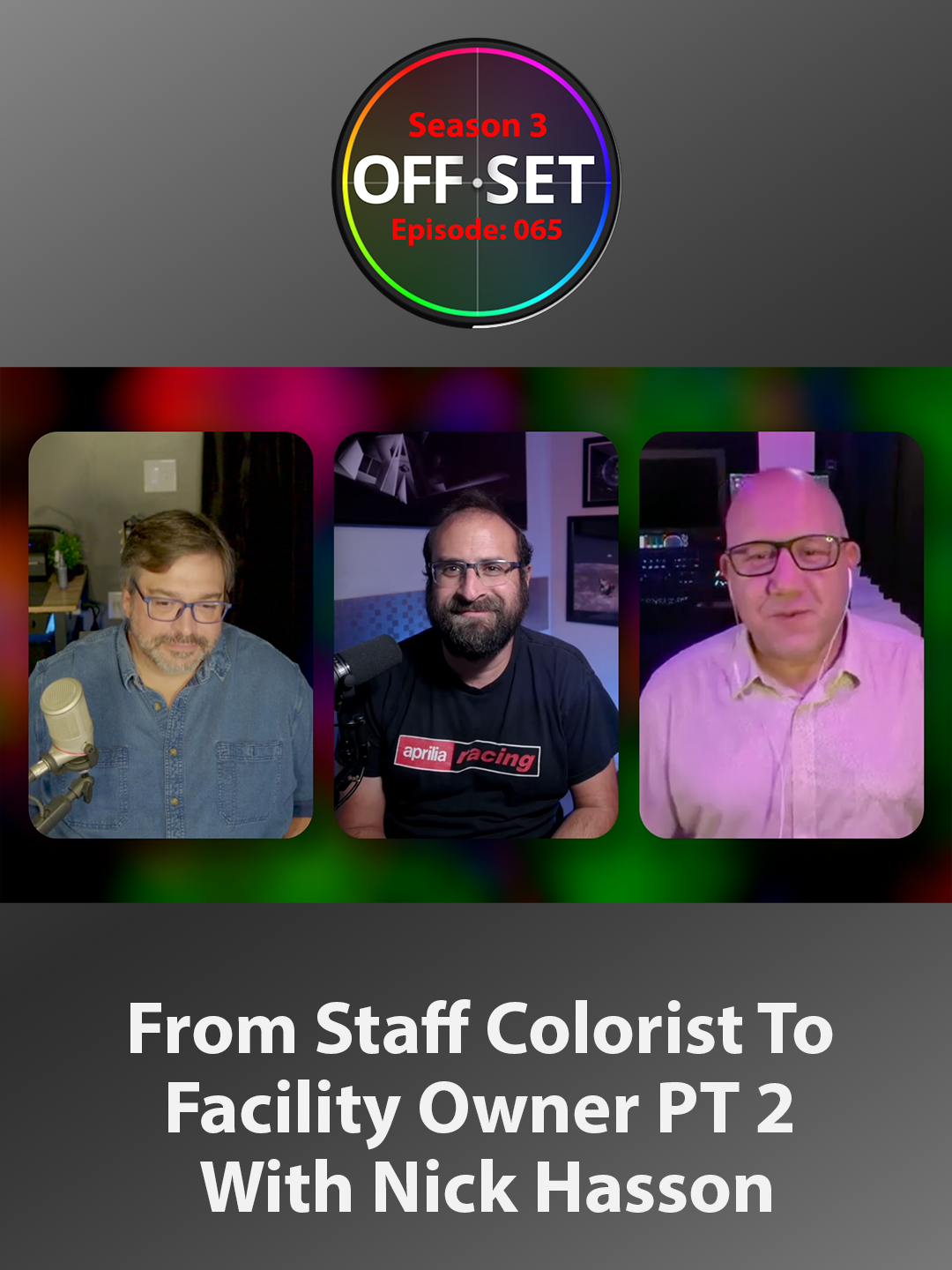
EP065: From Staff Colorist To Facility Owner PT 2 With Nick Hasson
Guest

Continuing Our Conversation With Nick Hasson
In this episode of The Offset Podcast, we’re once again joined by L.A. based colorist and facility owner Nick Hasson.
If you haven’t checked out Part 1 of our chat with Nick be sure to do so as it details Nick’s climb through the facility ranks in L.A.
In this episode, we get a little more big picture with Nick and explore the state of affairs of color, finishing and post production in 2026.
Specific topics include:
- Is the facility life right for everyone?
- Having the stomach for freelance life
- Vibe coding, gear and technology
- The perceptual impact of commercial space
- L.A. as the canary in the coal mine
- A.I. and its impact on post
- The right things to focus on for young colorists
- And more!
If you enjoy the topics and discussion of The Offset Podcast you can join in the conversation with our new Discord community
You can also follow us on Instagram & Facebook – just search for The Offset Podcast.
Be sure to like and subscribe to the podcast wherever you found it and be sure to check out our growing library of episodes. If you like the podcast it’d mean the world to us if you’d consider supporting the show by buying us a cup of virtual coffee –https://buymeacoffee.com/theoffsetpodcast
See you again in about two weeks for a new episode!
Video
Transcript
00:00:00:00 - 00:00:22:09
Robbie
Hey there, and welcome back to another installment of The Offset Podcast. And this week, we're continuing our conversation with Nick Hasson about sort of the state of affairs of post, his time in L.A., becoming a freelance colorist, a facility owner, and a whole lot more. Stay tuned.
00:00:22:11 - 00:00:44:12
Joey
Support for this episode comes from Flanders Scientific and their DM series HD monitors. From set to post to broadcast. These versatile HD monitors are equipped with an industry leading array of features and capabilities, making them indispensable to DITs, engineers, editors and colorists. Learn more at FlandersScientific.com
00:00:44:14 - 00:00:51:10
Robbie
Hey, welcome back to another installment of The Offset Podcast. I'm Robbie Carman, and with me, as always, is Joey D’Anna. Hey, Joey, how are you?
00:00:51:12 - 00:00:52:20
Joey
Hey, everyone.
00:00:52:22 - 00:01:09:03
Robbie
Alright team. well we are going to continue. We're going to dive right into this. No housekeeping this time. We're going to dive right back into our conversation with our good friend Nick Hasson about sort of his career path, his state of affairs in L.A,. the post scene in general. If you missed part one, go back and check it out.
00:01:09:03 - 00:01:21:05
Robbie
It's definitely a good listen, sort of out next time at a sort of facility and sort of what he's learned and sort of the school of hard knocks, if you will. Definitely some fascinating stuff. But we'd like to welcome Nick back in. Hey, Nick, how are you, man?
00:01:21:06 - 00:01:22:18
Nick
I'm doing good. Thanks for having me. Good.
00:01:22:18 - 00:01:40:17
Robbie
Good, good. Well, thanks for joining us again for this episode. We had a lot of fun talking to you on part one. And, you know, I think that sort of that peek into the kind of big facility life is, is interesting for a lot of people, you know, and I think one thing I was thinking of, I wanted to ask you that we didn't ask you on that other episode.
00:01:40:19 - 00:02:07:03
Robbie
In general. I think that, like me as a person, I never had the the tolerance for that kind of life. Right? I always like for the same reasons that I knew that I couldn't be in the corporate world or I guess in general, have a boss, if you will. Right. Like to to young folks these days. Like, would you, would you suggest the facility life like, you know, make a move to LA or Manhattan or one of these other big markets and kind of joining that?
00:02:07:03 - 00:02:22:18
Robbie
Like, do you, I guess, in other words, do you find it was valuable time and well spent time or do you think, yeah, I could have done this on my own and just been at the same spot. Like, I think it's a question that a lot of young colors have because, you know, moving to LA and trying to get a job at one of these facilities or whatever can be challenging.
00:02:22:20 - 00:02:37:03
Nick
Yeah. I think, you know, we talked about how important relationships are, and I think that's where a facility could hurt a young colorist, in the sense that sometimes you can't make relationships that you want to because there's, interfering factors and.
00:02:37:04 - 00:02:40:10
Robbie
There's a hierarchy of who owns that relationship and all that kind of stuff.
00:02:40:10 - 00:02:53:21
Nick
That as well as like, let's say you have somebody that wants to do a small film, doesn't have much money, you know, getting that into a big facility, maybe hard or it maybe I can get them in, but I can only get two days. Well three days. What are you going to are you going to do your best work on a feature in three days?
00:02:53:22 - 00:03:14:06
Nick
Probably not. You know. So so there's that. But the other thing I would really take my experience and push forward is you look at these big shows and you think that they're a goal, that they're this like Mark, right. Like this is a mark of success. And then what you realize is that's a lifestyle change. So you have to decide what you want in life.
00:03:14:07 - 00:03:34:07
Nick
Do you want to work on the big shows and be inundated with 6 or 7 day weeks and 12, 14, 15 hours a day and at everybody else's beck and call? Or do you want to be able to go home and have a good dinner with your family, or take a bike ride or do that? So that's the big shows and ruin your personal life.
00:03:34:07 - 00:03:49:06
Nick
And I think that's probably something I would think most people in every department of, of those would, would agree with. I think, you know, and so it's a matter of it looks good on the outside until you get there. And then sometimes once you're there, you realize you may not be that person that wants that lifestyle.
00:03:49:08 - 00:04:07:21
Robbie
You know, it's it's something that Joey and I talk a lot about of just sort of like, did you know, did we make the right choices over the years to grow the business and do that kind of stuff? And I, I am a firm believer of what I call the great middle. And unfortunately, we'll get into that just a second that that big middle is disintegrating before our eyes.
00:04:07:22 - 00:04:25:22
Robbie
But like that, you just hit the nail on the head I never had it was about lifestyle design for me, and I knew that if I was going to take that path, right, gone were I want to say, freedom. But you know what I'm saying, right? It's just it's a different type of path. And like, I was going to be in it to be in it.
00:04:25:22 - 00:04:44:01
Robbie
And yeah, I might eventually get an opportunity to work on, you know, a major, huge, gigantic film. But that wasn't worth the trade off to me for, you know, the flexibility, the sanity, you know, all of those kind of things. And so I'm not judging it, but I do think it's a it's an inflection point that I think a lot of colorists and people in post have to make.
00:04:44:02 - 00:04:52:06
Robbie
Right. Whether you want to be in that world, it means something. It means a lifestyle change, as you said, versus kind of being out on your own and doing your own thing.
00:04:52:08 - 00:04:59:23
Nick
Yeah, if you're at a big facility and you're doing $100 million movie, you do not own your life. Yeah. You do not in your life.
00:05:00:03 - 00:05:30:18
Robbie
So after years at ion Technicolor Light ion harbor, all these big facilities, you know you mentioned earlier in the, in the previous episode sort of, you know, not by choice, but just the way that things panned out. You find yourself on your own. Tell us about that. Because I would imagine that after years of being, you know, a staff person at a larger facility and now you have a young family and responsibilities and all that stuff, it probably was a little stomach churning to go, oh, crap, this is this is now me now, right?
00:05:30:18 - 00:05:33:05
Robbie
I got to join the freelance world. Tell us a little bit about that.
00:05:33:06 - 00:05:48:05
Nick
Yeah, yeah. So, I had a little bit of a leg up in the sense that, like, when I was talking about, you know, facilities, getting involved in the middle of a relationship. So over my time at the big facilities, I had lots of friends that are in makers, you know, when you you spent 20 years in LA, you're going to meet a lot of indie filmmakers.
00:05:48:08 - 00:06:08:15
Nick
Sure. So I was doing a lot of those projects at my house or, you know, supervised sometimes, sometimes not. So I kind of had this already, had this little bit of side business going for, you know, the number of years. And it was a side business. And since it was like, hey, so-and-so has a movie and this one has a movie, I'm going to do it and we're gonna renovate the kitchen or, you know, and that's that's what we used it for.
00:06:08:15 - 00:06:23:19
Nick
And I would work those extra hours for that. So when I was plunged into the freelance world, it was kind of great because I had stuff already set up at home. I didn't have quite the setup that I had that I eventually built, but I had a little bit of a network and I had a little bit of friends that I had been doing that for.
00:06:23:19 - 00:06:46:16
Nick
And so I went out into that world and kind of laid that out. The first thing I did was I gutted my garage. I have a backhouse that's separate from my house, and I gutted it, and we landed up, turning it into a small theater with, you know, a 5 or 6 home theater, chairs, a big 77 inch client monitor, the 831 ten in the back, you know, for the big console in the back and, you know, nice 5.1 sound system.
00:06:46:16 - 00:07:07:20
Nick
And so I started doing my the clients that knew me again, those relationships that I had that were like, I don't care where you are. I'm going to come to you and we're going to do the movie. And so so I started doing that as well as going out and freelancing and freelancing was an interesting, because what happened in LA in that time was, you know, the work to a certain extent, you could stay busy just being associated with a facility.
00:07:07:22 - 00:07:22:12
Nick
And that is really broken since the early 2000, that now it really is more about relationships. And that's, you know, nine times out of ten when you get a job, it's because it's somebody I worked with. And nine times out of ten, when I lose a job, it's because they already have somebody they work with, you know? So it was a very different time.
00:07:22:12 - 00:07:40:04
Nick
All of a sudden, the facilities didn't have enough work to even keep their staff busy. And so I kind of had to think differently. And so the first avenue I did was I thought, I'm going to talk to everyone I don't know. And I made a list of all the facilities and all the people I've heard of over the years and anyone that didn't know me.
00:07:40:05 - 00:07:59:05
Nick
And I went instantly into that called old school, picked up the phone. You're the operations manager. I want to come meet you. Let me come down there. And that's how I started freelancing and started going around and and the word spread through connections and networks and friends. And so I got to do some cool things at freelancing. And that's the great thing about freelancing is you can kind of choose what you want to do and what you don't.
00:07:59:06 - 00:08:16:02
Nick
And so I spent some time at The Sphere last summer working on the, The Wizard of Oz experience that they did, and that was very cool. And, you know, that's something I wouldn't have done at a big facility or on my own. And so that freelancing really helped. And the freelance was kind of a good transition into me working for myself full time.
00:08:16:05 - 00:08:32:04
Nick
So, the freelance work has slowed down a lot in LA. I will say, you know, in the last, in the last six months, you know, the facilities, the smaller facilities have really the, you know, it's kind of gone down and and the bigger facilities are from what I understand, they're running at 60, 70% capacity. So there's not a lot of freelance opportunities there.
00:08:32:06 - 00:08:40:12
Nick
So shifting into being rather than I'm looking at the facilities as a place where I'm going to go get work as to a place where I'm going to now try to be there. Competition.
00:08:40:14 - 00:08:59:00
Robbie
Yeah, yeah. So you said a couple of things there that I think Joey and I talk a lot about on this show is in besides the relationship stuff or whatever, is that, that soft work around being a freelancer or an operator yourself and you kind of mentioned, hey, I, you know, I, you know, cold called people and looked at the Rolodex or whatever.
00:08:59:05 - 00:09:18:14
Robbie
Like, I think that's an underestimated part of how challenging it is to be because there's some people who are, as you said earlier, you know, comfort, comfortable having these conversations with people. But it is a hard thing to be like, hey, we're going to do this creative thing and then turn to that same person and go, hey, let's talk about your lead invoice.
00:09:18:14 - 00:09:40:03
Robbie
Right? Like that kind of that kind of balance act is hard. Did that make you some some practice and some time as you got into that, that world to kind of finesse a little bit because I would imagine, you know, being in a facility, you had an account manager or a, you know, operations person doing a lot of that work, you know, representing you and doing that work for you.
00:09:40:07 - 00:09:40:13
Robbie
Yeah.
00:09:40:14 - 00:10:03:13
Nick
Producing is probably the most time intensive thing in, in my facility for me, you know, coloring. I spend maybe 60, 50% of my time, 60% of my time actually coloring. I spend so much of it producing a job. And I think what you learn is it's very hard to be the fun, creative and the bad cop that wants their money, and it's very hard for people to separate that.
00:10:03:13 - 00:10:18:01
Nick
And so what I learned was that you you can't go to a client at the end and say, hey, we're over, I need money. No one wants to deal with that. You don't want a contractor to come into your house, open up your walls and go, well, hey, I'm not closing it up unless you give me. You know, there needs to be an explanation in a process.
00:10:18:01 - 00:10:44:09
Nick
So I'm very big on what I call bid versus actuals. So every week I have a system. I have a system that I vibe coded where I put in work orders for the work we're doing. And the client has a log on that they can go on and they can see actually where their project is every Friday if they get if we do work orders, you know, Monday through Friday, they'll get an email that Friday night of what was done, how many hours they have in their bid versus how many hours they have left.
00:10:44:12 - 00:10:50:21
Nick
And what's that done? Is that put the, the, the responsibility on them to behave a little bit better.
00:10:51:03 - 00:10:52:18
Robbie
Manage the process a little bit better? Yeah.
00:10:52:19 - 00:11:08:15
Nick
Because they're watching the clock their own clock go. And so, you know I'll remind them that like hey guys, you know when they bring up ideas sometimes it's like, hey, you know, never in a room with creatives always later. You know, the creatives are creative. You keep it in the sweet. You never talk money in this week. It's not what it's about when you're there.
00:11:08:15 - 00:11:21:00
Nick
It's about the creative. And so later I'll often just update people and say, hey, you know, I heard you guys talking about these extra days down here, but I just, you know, this is where we're at right now. Just, you know, if there's if we need to, you know, it's never a this is a point where I want more money.
00:11:21:00 - 00:11:35:01
Nick
It's always a point of like, maybe we put it on hold for a couple days, or you let them make that decision of of what they're going to do. And it's a little bit easier to to be the bad cop in a nice way when you when they're presented with all the information and all the time, it's hard for them to deny it.
00:11:35:02 - 00:11:42:15
Nick
When you wait till the end and you go, hey, we spent all our hours and now you guys want this stuff and I want more money. It's it's very, very tough.
00:11:42:17 - 00:12:10:01
Robbie
Yeah. We just did an episode a couple of weeks ago about pricing and kind of thinking about bidding and that kind of stuff, and it's one of those things. I don't know, Joey. I think this we have seen this burn a lot of real freelance people, young colors, etc., because like these back of the napkin handshake kind of agreements like, you know, it ends up burning you and you have no ground to stand on.
00:12:10:01 - 00:12:27:13
Robbie
And I like your attitude of, hey, we're going to be transparent with the information. You can see the information, you can look at it anytime you want. So if they make the choice to like, you know, just unload on you with God awful changes and additional requirements, they're making that choice with operating from a point of having information.
00:12:27:14 - 00:12:28:07
Robbie
Right.
00:12:28:09 - 00:12:50:12
Joey
Yeah. And the hard part is really, as we've said a million times, it's a people business. You want to be likable. You want to be the person. You want somebody to work with. That when you're also either freelance or running a business, can be really at odds with the idea of actually having a successful business. And I've been so guilty of it so many times, like, I want this client to really like me.
00:12:50:12 - 00:13:03:17
Joey
So yeah, of course we'll give you a discount, we'll work on the weekend, we'll do this. We'll do. And it's very easy in the pursuit of wanting to be the colorist the client wants to work with, to let yourself get walked on.
00:13:03:20 - 00:13:20:14
Nick
Yeah, I think I learned a little psychology, too, which is every production is going to ask for something free. They always do something, whether it's minor or major. So I usually try to get ahead of that in the curve where it's like, hey, you guys wanted these outputs for quick times. Quick times are great. Free give because they don't take labor.
00:13:20:17 - 00:13:34:12
Nick
You hit render, they go time. Yeah, yeah, yeah. So it's like, hey guys, you know what? You guys wanted these extra quick times. I took care of it. And I'll put in a work order and I'll show that it was in no charge. And you do that a couple times on little things early because we got to remember, this is a service based industry.
00:13:34:12 - 00:13:49:11
Nick
That's what we're there for, you know. And so those little things can help also bring people back. Kind of like what do you want to call loss leader I guess in a way for some people. And so I find if I give those little things ahead of time, it's a lot harder for someone to come later and go, hey, I need this or I need that.
00:13:49:11 - 00:13:58:03
Nick
And it's like, well, you know what? I've actually already helped you guys and giving you this, so I can't keep going with that, that one we're going to have to go into over discord.
00:13:58:05 - 00:14:22:16
Robbie
Yeah. And I think that, you know, you mentioned that, you know, casually mentioned like, hey, I've just five coded the system. And I think that's actually an interesting insight because I think that, you know, ten years ago, looking at facility management, proposal management, you know, any of these, any of these things you had to do, it usually meant buying an overpriced piece of software or a subscription or that kind of stuff.
00:14:22:16 - 00:14:41:05
Robbie
And now it's just like an amazing time. Like I, you know, I've talked to you offline about this, about some of this vibe coding stuff. Not and it's like, no, now you can identify a problem, address the problem. And like really what you're saying is that you're giving information to make your clients life a little bit more easier, like easier, more transparent.
00:14:41:05 - 00:14:57:03
Robbie
Right. Like they don't have to go digging for the information and call. You get this invoice. It's like it's always their life. And I think the more that people can do on that front and sort of anticipate what the clients are going to ask, what they're going to want to look at, and especially now being able to make those tools to do so.
00:14:57:05 - 00:14:58:14
Robbie
It's pretty damn cool.
00:14:58:16 - 00:15:15:10
Nick
Very cool. And, you know, there's so many things you can do in there. And one of the things I did as well that landed up not working out. So one of the things I've done for the clients is they can log into the portal and they can see all their, their work orders. And initially I thought, oh, this would be a great way for them to schedule sessions and I don't have to deal with that.
00:15:15:10 - 00:15:34:19
Nick
It could take some weight off of producing. So I started doing that. And what I found out was that that them dealing with a computer and not a relationship became a very bad thing. And if they want like I want these days and it's not available, and they get an email from a system that says, no, it's it's.
00:15:34:21 - 00:15:36:09
Robbie
All right. Right, right. Exactly. Yeah.
00:15:36:11 - 00:15:45:20
Nick
So that was some of the cases where vibe coding I thought would really take the lifting off. Yeah. And it's it's always about that personal touch.
00:15:45:21 - 00:16:24:21
Robbie
Support for this episode comes from Conform.Tools. Conform.Tools converts timelines between Premiere, Media Composer, Resolve, and other NLEs - automatically handling what you'd normally fix by hand. Things like speed ramps, keyframes, repositions, and even Sapphire effects. And when it's time to move media, send massive projects to collaborators in minutes instead of hours. Conform.Tools only transfers the media your timeline actually uses without you even needing to trim or consolidate media. Built by post professionals, Conform.Tools helps editors, colorists and conform artists move faster and finish stronger.
00:16:24:22 - 00:16:33:17
Robbie
Let it handle tedious stuff, so you can focus on the creative. Start a free seven-day trial at Conform.Tools
00:16:33:19 - 00:16:50:10
Robbie
It's funny because Joey and I have had a lot of conversations about he's a lot. He's a lot more pragmatic than I am about you. I'm always like, I get deer in the headlights and I'm like, no, but we could just make this thing and it'd be so cool. And then you end up realizing that you're just kind of a slave to the system and all.
00:16:50:10 - 00:17:08:03
Robbie
All it's doing is kind of like making you feel cool, that you like vibe coded something or whatever, but like, what's the purpose of this? Like, nobody's going to use this, like move on. So that's a, that's a that's a great case in point. Now I wanted to go back to something about this, this awesome home studio that you had for a while.
00:17:08:04 - 00:17:29:06
Robbie
Right. Because one of the things I was when we first started becoming acquaintances and then, you know, talking more often, I was always impressed by this studio because a, a detached studio in my backyard is like a dream of mine. Like, I would love to have that two. It was like, oh my God, you got like direct view, you got projectors, you got all that kind of stuff.
00:17:29:08 - 00:17:54:08
Robbie
And I just have to ask, like, it seems like you're into the technology and into the gear and into the engineering side of that. Is that something that you've always sort of had? And like this was just kind of like, cool. Now I can just put it on full display or like, where does that come from? Because I think there's a lot of people who get intimidated by all the technical engineering kind of stuff and like, like Joey and I, you're into that kind of stuff.
00:17:54:08 - 00:18:00:09
Robbie
And I'm just curious, like where where that came from and why you find it fun and exciting.
00:18:00:11 - 00:18:19:08
Nick
I grew up with a dad that fixed everything, and when something broke, you fixed it right? And that usually meant breaking it more before you fixed it. Yeah. So I think it's. But I think it all goes back to problem solving. I think that's really what it is, is like I like those problems and those challenges and. Yeah.
00:18:19:09 - 00:18:28:20
Nick
And I've learned and and and just I do like the technical stuff. It's great when you get it working and you've got a system and, and you've designed it to work the way you want, you know. Yeah.
00:18:28:21 - 00:18:47:09
Robbie
Yeah. For sure. That's just interesting because I always, I always and when we were, when we would do, do calls and I would see you from your studio, I was just like, this is like a facility in your backyard. It's pretty cool. Now, speaking of which, you recently made a jump from the backyard facility to a real facility.
00:18:47:10 - 00:19:03:02
Robbie
Tell us a little bit about that. What it's called. Why? What was the motivation in doing this? I'm guessing that this had, you know, sort of I've thought I've had this challenge myself going, okay, I'm doing a lot of work from home. The office balance, you know, like, I don't want people coming over to my house. I want them to come to the facility.
00:19:03:04 - 00:19:09:05
Robbie
Was that part of it or was there something bigger going on that kind of informed your decision to kind of get into office space?
00:19:09:07 - 00:19:37:00
Nick
Yeah, it was two things. So in the beginning it was great. And then when you're constantly cleaning and you constantly have people at your house, or especially when you got to the summer and the kids want to be in the backyard with all their friends, but your room is right next door, you know, those become become problems. I also think that my house was built to a professional level postproduction technical spec, so if you went in there, it was the same equipment, the same standards that you would have at a post house.
00:19:37:01 - 00:19:56:19
Nick
Being at home gives it a certain perception to people. And so that that it was it was those two things. It was one changing that perception that I'm not just a guy at home and that we have capabilities to do more than just, you know, a small job. And it was also, I think, getting the clients removed from the house so that my wife and daughter didn't leave.
00:19:56:21 - 00:20:20:05
Robbie
Yeah. You know, it's funny because, Joey, I think you understand this as well. And that is I, I have always like the thought of, like the flexible work day. Come downstairs at, you know, 10:00, you know, to get something done, do a conform, whatever. Like there's a lot of pros to that kind of work from home, you know, having a capable set up.
00:20:20:10 - 00:20:38:17
Robbie
But there's also a lot of downsides. And I feel like for a while I kind of was like, oh, man, I hate paying rent. I hate the, you know, the commute, all that kind of stuff. Recently I've really been down on kind of like the work from home kind of thing for, for, for, for reasons that don't really are not all that tangible.
00:20:38:18 - 00:20:58:03
Robbie
Like for me, it's more of just like, oh, when's the last time I left the house? Okay, that was a week ago, right? Or like, you know, or or I feel like, you know, it's 11:00 at night and somebody just sent a file. And when I was having to go to the studio all the time. Right. Like, that's like, that's a tomorrow problem when I get to the office.
00:20:58:08 - 00:21:15:03
Robbie
And now I'm like, I'm feeling it's 11:00, I'm watching a show or whatever on the couch. And I feel this pull right, this pull to go downstairs, just take care of it. And I imagine like that's to you. Also you're speaking to more of like the work life balance. And it sounds like you got to a place with.
00:21:15:03 - 00:21:19:06
Robbie
Yeah, working at home is cool, but it's nice to go someplace every day.
00:21:19:11 - 00:21:42:01
Nick
Yeah. And I still have my place at home, so. And, you know, I learned a lot from your guys. Multi-site, you know, setup that you guys have and how you did it. And so everything mirrors both places I can work in either place unless something's cached. I can't cache, you know, in both. But unless something, you know, needs that, I can sometimes I do all the non color stuff at home so early in the morning, you know, I'll get up early.
00:21:42:02 - 00:21:55:22
Nick
I'm a very early morning person, so I may start doing a conforme at six in the morning. You know, work on that till 730. Get my daughter up, get do the morning routine, drop her off at school, then come to the office and I can work for, you know, the rest of the day at the office and then head home.
00:21:56:00 - 00:22:06:06
Nick
Or like you said, I think the other thing too, is having that flexibility that like, I don't feel like at 11:00 I have to go in there anymore. But I also feel like if something comes up at 11:00 at night that I have to do.
00:22:06:07 - 00:22:06:17
Robbie
You could take.
00:22:06:17 - 00:22:07:03
Nick
Care of it.
00:22:07:03 - 00:22:09:05
Robbie
I could have enough flexibility.
00:22:09:06 - 00:22:27:06
Joey
I would say I love working from home because, you know, like you, I built my home office to be exactly what I want, you know, to the point of my basement was unfinished when we bought this house, when I decided to build a home office, which was pre-COVID. So it wasn't really a necessity at the time. I just wanted the home office.
00:22:27:08 - 00:22:51:09
Joey
I, I had a contractor come in and build out the basement, including a climate controlled machine room with extra installation insulation to make it quiet, rackmount, extra power circuits to everything. So, like, this place is built to my spec, right? And I really love working here. But the downsides are I'm looking around right now. I was doing some modification to some wiring and some workstations, some servers.
00:22:51:09 - 00:23:12:12
Joey
So the entire place is a complete disaster. There's nobody you can't see it from this angle, but there's wires all over the place over there. There's trash bags over there, about a hundred Amazon boxes over there. Right. And my motivation for finishing that job is a lot different when it's just my basement than when I've got clients coming in next week at the office.
00:23:12:13 - 00:23:33:05
Joey
I need to have this place buttoned up. But the other hard part is that presentation and that image. I have maybe three, 4 or 5 clients that I've known for years. They've been to my house anyway, before I even had a home office. They come by and work here. Great. That's a lovely experience. That is the exception, not the rule.
00:23:33:06 - 00:23:52:19
Joey
And that can be a serious limiting factor to what jobs you can get and what jobs you can have success with. You know, you could get the job and then the client kind of halfway through realizes, hey, this isn't really working because I can't come in. And then you never want that because you're leaving a bad taste in the client's mouth.
00:23:52:19 - 00:24:15:10
Joey
So I love that idea of I have a mirrored system at home in the office. I can use each one for the appropriate tasks, times, whatever to because that'll help you manage your schedule. Like you mentioned. You know, you you get up in the early in the morning, you save that traffic, commute, get some stuff done. So your day at the office is easier and smoother.
00:24:15:12 - 00:24:34:07
Joey
That's a perfect use for the home office for someone like me, where it's like, yeah, we only have the home office when we had the the, the, the bigger facility. It was really nice for big projects because like, we had feature films that would come in and we'd come in and do like a session with the DP session with the director set looks for every scene.
00:24:34:13 - 00:24:47:05
Joey
I'd go home, grade the whole film, then come in the next week, hit play. No surprises for anybody in the review session. But now the clients have a nice room, so that's kind of when you're setting this up, you got to really think about those things.
00:24:47:06 - 00:25:03:13
Robbie
Yeah. It's it's and it's a good it's a good segue to what I want to ask you next. Because the problem, the challenge that we had, at least in this market, was that once we were through the pandemic and, you know, all that kind of stuff, we couldn't pay people to come back in to the facility. Like, you know what I'm saying?
00:25:03:14 - 00:25:13:05
Robbie
Like, we like every opportunity we got, we were like, we'd love to have you come in and sit here and people like, nah, cool, can you just send me a link or can we do a live stream?
00:25:13:06 - 00:25:21:15
Joey
A big difference, I think, in the markets between like LA and the East Coast is that most of our clients kind of got rid of their offices and moved to working from home also.
00:25:21:19 - 00:25:23:10
Nick
Yeah, I think it's a job. I think.
00:25:23:11 - 00:25:24:11
Joey
Something's lost there.
00:25:24:13 - 00:25:30:04
Nick
Yeah. I think, you know, for me my bread and butter is is features. And they always want to be here. They're excited.
00:25:30:09 - 00:25:31:13
Robbie
Yeah. Yeah. It's an experience.
00:25:31:15 - 00:25:55:00
Nick
It's an experience. The short form stuff for sure. People are you know not even into it. They're like some of them do, some of them don't. And I prefer I actually push in person. You know, because I believe that also helps that relationship. I think it's different when someone comes in, you know, if you're paying for a session, I'm buying you lunch and we're having a meal and we're hanging out and I'm going to talk about, you know, personal stuff and, and try.
00:25:55:02 - 00:26:09:14
Robbie
And let you put I mean, whether you do this for real or not like it is, it is a little bit of dog and pony show that you cannot replicate in other in that remote way. Right? Like, like I remember the early days of resolve and showing people like the resolve.
00:26:09:16 - 00:26:10:15
Joey
I kind of miss it.
00:26:10:16 - 00:26:36:12
Robbie
And people be like, oh my God, what just happened? And all you're doing is tracking a window, right? Yeah. Like the cloud, the cloud of points comes up and it happens in two seconds. And like that kind of thing seems silly to us, but it has a purpose and it has a confidence builder and it has that show off factor that you can't, I can tell you from doing, you know, thousands of live streams that you just cannot replicate in that remote kind of workflow.
00:26:36:13 - 00:27:11:02
Joey
It reminds me to to go back to what we were talking about way early in the, in the last episode in the in those days, because I love my quantal because it was so interactive, that system you're like throwing clips around the desktop almost. Right. And like we talked about, I've worked on every when I was at a facility we had at at one time, we had linear suites, avid smokes, avid DS and then the quantal, and then so I was using jumping between system to system to system every day.
00:27:11:04 - 00:27:29:07
Joey
Depending on the job. And I had one client that that I go way back with. So I've worked with this client in every room, basically in the facility at one time or another. And she once said, my favorite. She said that her favorite system to watch me run was the quantal, because it looked like I was having.
00:27:29:07 - 00:27:31:12
Nick
Fun, I love that. Yeah.
00:27:31:14 - 00:27:31:20
Robbie
Yeah.
00:27:31:21 - 00:27:34:03
Joey
Do that on a live stream. It just doesn't work.
00:27:34:08 - 00:27:49:13
Nick
No, I think there's things with the live stream too. I'm sure we've all experienced where someone's like, I want a little more saturation. Okay, get it back. No, I want a little more saturation. And you're like, you know, you've already gone up 20%. 20%. And there is a lot, you know. Yeah, it's it's tough.
00:27:49:18 - 00:28:08:07
Robbie
And there's that, that, that factor to that I can't, I can't I mean it's just the modern way of doing things. But like, you know, there's something to be said about the time and effort loss with tweaks like you just mentioned that could be solved so much, you know, by looking at, you know, grade one reference monitoring in the same room.
00:28:08:12 - 00:28:30:17
Robbie
And it's like, no, that's the truth. And it's like it's not saying anything groundbreaking here, but it's a real challenge with those remote workflows because, you know, who knows what somebody. I had a client the other day was like, yeah, the contrast just seems so flat and it just seems like washed out. And I ultimately determined that they were watching on a laptop on their back deck, you know, drinking their morning coffee.
00:28:30:17 - 00:28:59:08
Robbie
And it's like, did you not think that your viewing environment was like, oh, I like things that they wouldn't think about coming into a calibrated, you know, properly set up room are now real issues that we have to deal with. Right. So, so let me ask you this, Nick. The I think for 50 years, 700 years, whatever it's been, you know, LA has sort of been sort of the canary in the coal mine of the sort of the health and state of the industry, right.
00:28:59:08 - 00:29:20:19
Robbie
When you know, a lot, you know, movies are coming fast and furious. The industry is doing well. People are all working like, I know you don't speak for everybody in LA. I'll just I'll just say that right off the bat. You know, you're one, one man with one opinion. But like these days, it's kind of hard to tell from again, the other side of the country, like what the scene is like in LA, what the state of affairs of.
00:29:21:00 - 00:29:36:16
Robbie
Could you just give us your opinion, sort of on the general state of affairs of the industry out there, because from a far it seems like lots of people are struggling, works tight, you know, that kind of stuff. What is your, you know, your finger on the pulse out there? What is what do you think's going on? What's the state of affairs?
00:29:36:19 - 00:29:55:15
Nick
Yeah, I think it's a couple things. I think, you know, TV had an implosion a couple of years ago and LA was a TV town. I live in Burbank, and, you know, I go to a lot of community events. I would almost 11 year old, know lots of people. Everyone made their their living in production in TV. And so that going away was a big hit.
00:29:55:15 - 00:30:16:15
Nick
And early on, the people in production got hit first and hardest and longest. And it seems like that's not gotten better, but maybe stabilized at least a little bit. So there's not enough for everyone. But it seems like everyone I know is working somewhat, and they've adjusted their lifestyles or figured it out, or another spouse is maybe helping.
00:30:16:15 - 00:30:37:12
Nick
And so they figured it out. But I think, you know, that K shaped economy we talk about I think TV was that middle. I also think with movies as well. You know, for years my bread and butter was these like ten to maybe $30 million movies. Those are not around anymore. They're very rare. And now they're 2 to $5 million movies, you know?
00:30:37:13 - 00:31:08:22
Nick
So it's very different. But I think, I think the biggest thing too, in LA is that everyone is still in a pause for a lot of things, this Paramount Warner Brothers merger and what that's going to mean, the tax break that they're trying to pass, the California post-production tax break, I've lost three jobs in the last two months to out of country bids that couldn't compete with, and even what's interesting is even with the travel costing them more and maybe pushing them over, these productions will still take the lower cost for some reason, which is interesting.
00:31:08:23 - 00:31:30:01
Nick
Maybe they want the vacation on the on the on the productions dime. So I think LA is at a point where it's kind of stabilized from where it was a couple years ago, but we're still in this spot of nobody knows. And I think until until those issues or maybe this federal tax credit that they're talking about, you know, out here, the bulk of the work is at least in everyone I know is TV and film.
00:31:30:01 - 00:31:33:00
Nick
So those things really affect TV and film.
00:31:33:02 - 00:31:58:07
Robbie
Yeah. The pause and delay part. Joey and I were actually talking about this this morning, is that it just seems like and I mentioned that sort of that great middle, you know, the, the reality television, the, you know, the thing that, you know, the my ten zero zero 0 pound life kind of level show that, you know, everybody, everybody you know, on but for a lot of people was their bread and butter, including ours that has just has gone away.
00:31:58:07 - 00:32:24:15
Robbie
It has disappeared. And for us like and I'm interested in your point of view on this because for us the short form work hasn't gone away. And if anything it's picked up. But the challenge of it is that it's really hard to plan your life around a 32nd spot, right? Like you can't be like, hey, I'm budgeting for the rest of the month or the quarter or whatever based on that commitment, because it's it's like, hey, we're going to tell you about it the day before.
00:32:24:16 - 00:32:40:11
Robbie
Can you do it tomorrow? And it's done. It's very transient, you know. And for us, we've struggled a little bit with the idea of like, okay, the the long form stuff is not as omnipresent. We can't plan the next quarter or half a year or whatever around a commitment. How are you juggling that with with the scene out there?
00:32:40:11 - 00:32:51:21
Robbie
Because it sounds like you are doing quite a bit of long form work, but is it still, you know, is that challenge still present for you about kind of, you know, balancing the stuff that you can plan around versus the stuff that just shows up on your doorstep?
00:32:51:22 - 00:33:08:02
Nick
Absolutely. And one of the things I did to get ahead of that was to offer dailies and to jump in on these movies and get them early and know that, you know, okay, now I've got them doing dailies. I know it's, you know, 16 weeks, roughly. When they finished, I'll see them roughly. And so you kind of get in there early.
00:33:08:04 - 00:33:26:15
Nick
That's the key. What I've seen in the short form world, I don't do a lot of commercials, but when I do, what I've seen happen out here, I think is over the last number of years has been a lot of colorists, freelance colorists that work at home, that can do these remote sessions for ad agencies. And what I've seen over the time is they work at a freelancer rate and not a facility rate.
00:33:26:17 - 00:33:36:12
Nick
And I've seen that kind of circle back around when we get jobs, you know, coming in with major brands that are like, hey, we've got this major brand, we've got two 92nd spots and two 30s and some.
00:33:36:14 - 00:33:37:01
Robbie
500.
00:33:37:01 - 00:33:53:09
Nick
Bucks, right? And we've got $1,500. And you're like, well, that's that's kind of ridiculous. A little crazy, right? So I've seen that kind of hurt them, I think hurt the market a little bit. And then the big companies, I think too, are a little guilty because to a certain extent they're a Ponzi scheme. They want cash in, cash out.
00:33:53:09 - 00:34:12:18
Nick
And that doesn't mean a jobs profitable. Some of the features that I'll bid that I'll lose to some of the, you know, the bigger facilities, I'll know the numbers for me and I'll look at it and go, this is okay. Like, it's fine, I'll make a living, it's fine. And then a big facility takes in. I'm thinking, there is no way that they are making money on that job with their infrastructure overhead.
00:34:12:19 - 00:34:18:06
Robbie
Overhead. Yeah. Yeah, totally. They just want the they just want the perception of being busy and having the work build.
00:34:18:08 - 00:34:32:03
Nick
Yeah. And so I think that that trickles a lot in LA. I think if LA is higher and can get busier then, you know those jobs will fill those bigger facilities. They won't take those jobs. Those will allow the smaller guys to take, you know, get their porn back, you know.
00:34:32:04 - 00:34:50:06
Robbie
Do you think, I mean, we mentioned vibe coding earlier. Do you feel I'm curious about your, you know, high level view of the world of al AI and, you know, every, you know, there's a there's a lot of feeder that goes on with this. Of course, people, you know, screaming from the rooftops, staking everybody's job. It's the end of the universe.
00:34:50:06 - 00:35:13:00
Robbie
ET cetera. Like, I don't know, I land somewhere a little more pragmatic on this kind of thing. I think that AI is great for workflow and number crunching type, you know, programing. As we mentioned earlier, I'm not convinced about generative work really at all as being a long form thing. But I'm curious, like, is that a struggle or something that you're considering now as a facility owner or whatever?
00:35:13:06 - 00:35:29:13
Robbie
Like how is that? How do you see that impacting things in general in our industry, but also specifically in LA, because you hear about it a lot. You know, you go on a Facebook group and everybody's like, oh, hey, I was going to take our jobs. That's the end of the world. Like, what's the what do you what do you feel like that that's landing right now?
00:35:29:15 - 00:35:45:03
Nick
Like it's all true, but maybe the timing is wrong, you know, in the sense that, like, yes, maybe AI will color stuff for us, but we're not there yet and there's a lot of danger with it. I mean, the, the, the recent resolve release, you know, tying into Claude, you know, I watched a demo of it and I was like, wow, that's amazing.
00:35:45:03 - 00:35:57:13
Nick
But then when you break it down, you look at it and you go, you just asked Claude for a pro reds to render. Well, what ProRes, what frame rate, what audio config. What tag. You know. So there's a lot with that.
00:35:57:14 - 00:36:00:04
Joey
And it also just deleted your whole database for fun.
00:36:00:06 - 00:36:00:16
Nick
And so.
00:36:00:17 - 00:36:04:12
Robbie
So Joe, Joey's a lot more skeptical than I am of these things.
00:36:04:12 - 00:36:05:14
Nick
I'm well.
00:36:05:16 - 00:36:26:09
Robbie
I'm wowed by the robot. I think the robot does some amazing things. And, you know, I tend to turn a blind eye a little bit to the hallucination, hallucinations and and mistakes because I'm floored by holy crap, I got an application up and running in and afternoon. Right. But like, I think you're I think you're generally right. I think that I guess my question is a little bit more nuanced than that.
00:36:26:10 - 00:36:48:06
Robbie
Like, you know, the, the if we believe the narrative we are all out of, we are already all out of work because this is just going to take over and I guess, do you instead another way, do you think the human factor will always have a role in post-production, or do you think there's a time where we are just, you know, watching the machine do its thing?
00:36:48:07 - 00:37:11:09
Nick
No, I think it's always going to have to be that way. I mean, especially in the, in the episodic, long form feature world, because, you know, these clients that I work with, they focus on that. They're storytellers, they're not digital people. And so, you know, I've got some clients that are amazing storytellers, amazing directors, amazing DPS. And if I put them in front of an AI, they're going to last about three minutes before they're frustrated and not want to do it.
00:37:11:12 - 00:37:31:13
Nick
And so I think it's also that thing of trust too, which is like especially on episodic shows where it's like they're so fast that they have to trust that you know what they want and that it's going to be repeated. And I don't think you get that out of AI. So there'll always be that good enough people. You know, the, the I mean, we see it in when you talk about generative, I don't I'm not a fan of generative either.
00:37:31:18 - 00:37:46:19
Nick
And you see it on on social media ads and it's like fine, good enough. But I don't think we're going to be going to this, you know, spending $20 for cinema ticket to go watch, you know, AI driven, you know, movies. And if they do, it will be a category like animation. I think.
00:37:46:20 - 00:37:48:08
Robbie
It will be a right. Exactly.
00:37:48:09 - 00:37:48:18
Nick
My.
00:37:48:19 - 00:38:15:06
Joey
My opinion on this is and has always been that, like Robby said, AI is great for what I call moving numbers and text around. Yeah, writing code, doing workflows, stuff like that, freaking great at that are within its limits, generative as in whole. What I refer to as whole hog image generation. I am going to describe something. You're going to make me a picture or a series of pictures, if you will, a motion picture.
00:38:15:09 - 00:38:38:19
Joey
Right? And people say, I am a I have been accused of everything under the sun for making this statement, but I will stand by it. Generate whole hog image generation will never ever, ever be good enough. And the reason I say that is we can mathematically look at it. We can say every step forward is half as far forward as the last step.
00:38:38:22 - 00:39:00:15
Joey
And if the uncanny valley is here and we are a exponentially decaying curve of diminishing returns, no matter how good it gets, it will never cross the uncanny valley. Does that mean it's not great for making mattes? Of course it is. Is it great for helping with green screen keys? We've already seen that with things like what? Corridor.
00:39:00:16 - 00:39:02:05
Joey
Is it corridor key?
00:39:02:07 - 00:39:02:11
Robbie
Yeah.
00:39:02:12 - 00:39:26:12
Joey
Quarter key. That does some incredible stuff with with green screens. And then you know, all of these things, these making elements. There is use for some kinds of generative AI. But making a whole image I don't think will ever be good enough. I don't think mathematically can ever be good enough, except for what you just said, the good enough of garbage on social media.
00:39:26:14 - 00:39:34:23
Robbie
But that also doesn't mean that that also doesn't mean that it has. It can play a role in, you know, abstract background generation or a problem or something.
00:39:35:02 - 00:39:57:14
Joey
But one other thing I want to say about that is that partially, it's up to the consumer, because the other thing AI can never make is a new image, right? It can't sit there and think, I'm going to photograph something new that somebody never photographed before. It is always going to be an amalgam in amalgamation of all the media that it has absorbed in its training to its.
00:39:57:16 - 00:40:02:17
Robbie
Its beauty is what other people have called beautiful. It's not crazy.
00:40:02:19 - 00:40:29:18
Joey
So the consumer needs to decide. One is this Facebook garbage that looks almost like real people, but the motion is quite a little bit off sometimes. And the the way they talk, the syllables hit the wrong spots just a little bit. Is that good enough for all my entertainment needs moving forward? And is the library of entertainment up to this point in humanity's history drawing a line, is that good enough for everything to be derivative of?
00:40:29:19 - 00:40:34:03
Joey
I think for that hopefully is no on both fronts.
00:40:34:05 - 00:40:35:08
Joey
Support for this episode
00:40:35:10 - 00:41:07:00
Joey
comes from Flanders Scientific and Gaia Color AutoCAL and Analyzer. Accurate calibration and routine verification are critical in our industry, and Gaia Color makes the calibration process both fast and convenient. Available across supported DM, XMP and XMP C series monitors, Gaia Color allows a wide range of compatible measurement probes to connect directly to the monitor for automated calibration and objective performance verification without an external computer or calibration software.
00:41:07:02 - 00:41:11:15
Joey
Learn more at FlandersScientific.com
00:41:11:16 - 00:41:40:20
Robbie
I guess the reason I'm asking is asking the general question to you is just sort of like, you know, the, the if we're if do you believe that to a certain level as operators, post-production specialist, we have to know this stuff and at least be proficient enough in the conversation. Because if we're not, if we take the attitude of no, this is just stupid stuff, it's computer nerd stuff, like the industry is going to pass us by for not at least hip to some of this stuff, right?
00:41:40:21 - 00:41:57:07
Nick
Yeah, you got to find it and you got to break it, and then you got to find where it works for you, you know? So I think with the color stuff and AI, you know, coloring for us, I think that's a hard sell for me because, you know, when you sit down on a panel and your and you're grading, you're often making little tiny decisions that I don't think an AI can make.
00:41:57:08 - 00:42:13:14
Nick
And everything in color correction is for me is two moves. If I'm going gamma down, I'm usually going highlights up at the same time, or if I'm going, you know, shadows up, I'm going gamma down. And there's all these little nuanced decisions that you make with all your experience that leads you to, to to know that and how to do it fast and not throw it off the belt.
00:42:13:14 - 00:42:14:00
Nick
But and.
00:42:14:01 - 00:42:15:11
Robbie
That analogy.
00:42:15:14 - 00:42:15:23
Nick
Yeah.
00:42:16:00 - 00:42:37:03
Robbie
And it's not it's not even that's not even to mention preference. Right. Like you your your preference might be that the image looks one way or the other. And I think it's also like this idea that it's all just auto magical. I mean, I've experienced with some of the stuff where it's like, okay, I'm now at prompt number 374, trying to get this to look right.
00:42:37:03 - 00:42:46:14
Robbie
That's real work, right? It's like this idea that, like, we can just tell it one sentence and it pops out. Perfection is not really the way it works.
00:42:46:15 - 00:42:46:22
Nick
No.
00:42:46:23 - 00:42:49:10
Joey
And that's 1500 shots in a show.
00:42:49:11 - 00:43:08:16
Nick
And where it does work, brilliant is, you know, the other the other week I had a movie come out in theaters and the studio wanted stills. They wanted frame grants. And so I get literally 400 frame grabs from a quick time of some studio person. And there's luckily there's a window burning at the top. And so I thought, wow.
00:43:08:17 - 00:43:14:01
Nick
And of course it comes at 5:00 at night. And they wanted that night, you know. Of course. And so I thought.
00:43:14:03 - 00:43:16:20
Robbie
I use right there. And I was having the numbers.
00:43:16:20 - 00:43:17:21
Joey
And text around.
00:43:17:22 - 00:43:35:05
Nick
Yeah, I really just threw the stills into Claude and said, there's timecode in the top left. Please make me a list as they happen. They did that. I took that list, threw it back in and said, make me a 3600 where these time codes are one record, one frame long record events. I threw it in resolve, I hit conform, I hit export, and it was ten minutes.
00:43:35:05 - 00:43:55:16
Robbie
And see, I think, Nick, what you what you are alluding to, there is something that I think is a missing component in the world will wrap up this conversation. The missing component in the young colorist. Mine. Right. You were able to make a connection between stuff that I know from like a historical point of view. You knew what a EDL was.
00:43:55:16 - 00:44:17:05
Robbie
You knew what CMC's 3600. You had that experience and combine it with this new stuff. And to a certain degree, that's always existed. But what I fear is that the new range of colorists, editors, post-production operators, they don't have I mean, I can't tell you how many times I have conversations with people about what timecode actually is drop frame, non drop whatever.
00:44:17:07 - 00:44:35:11
Robbie
And Joey, don't get them. Don't get them on a rant about editors who use 12 tracks of video because we'll be here for the rest of the day, right? So I think it's interesting, like where the the young operator is now is that they don't really know some of that history and not their fault. I'm not I'm being a little old man, get off my lawn kind of thing at the moment.
00:44:35:12 - 00:44:55:19
Robbie
But like, how do we reconcile that with the younger generation? Because I feel like, all right, if we've lost the facility, if we've lost that mentorship angle that happened there, if we've lost the screw ups, that can happen there and we've lost that in, you know, sort of institutional knowledge that can only be gained through hands on time with some of these processes and systems.
00:44:55:21 - 00:45:11:10
Robbie
What hope is there for post-production in the young colors? I'm curious about your opinion about that, because to me, like I'm simultaneously really down on the future, but also like, I don't know what's going to happen here. This could be cool. I'm curious what your feeling is.
00:45:11:12 - 00:45:30:09
Nick
I think your relationship and our relationship, our relationship is the exact is what needs to happen in the sense that we met online in a very closed door community, in the sense that it wasn't the open internet. So you could speak freely and you could put things. And there's people you personally know in there, and I think that's invaluable.
00:45:30:10 - 00:45:40:10
Nick
I mean, there were things that you guys helped me with when I started my business that I couldn't get answers on, you know, and I'd go to that community and go, how the hell am I going to get this Leo thing? How am I going to get this to work? And how am I going?
00:45:40:11 - 00:45:42:21
Robbie
Don't get me started on fucking LTL. Yeah, we've.
00:45:42:21 - 00:45:44:12
Joey
Had a bad week with LTO.
00:45:44:14 - 00:46:01:09
Nick
Always, always. So I think it's that community. I really think it's community. I really think it's people. I think that's that's what it's what's going to save everyone and what's going to help, you know. And one of the things I'm doing with my new facility is that I rent it out to some of the younger guys that don't have places to great to work.
00:46:01:09 - 00:46:10:04
Nick
So I have I've already done a couple sessions where, you know, gentleman comes in with a little SSD plugs in. He's got the room, I go home, I work, he's here working and it's great.
00:46:10:05 - 00:46:16:00
Robbie
That's the that's awesome. You're making you're having income when you're not using the room and you're helping out something that's the best both worlds.
00:46:16:00 - 00:46:35:14
Nick
Yeah. So I think community, it's all about that. I don't think if we if we, you know, fight in fight with each other and don't share this information and don't try to help everyone falls. You know, it's the saying high tide lifts all boats, you know. So I think I really do believe in that. I don't think color correction is at the point anymore where it needs to be a secret door.
00:46:35:15 - 00:46:36:08
Robbie
Or whatever. Yeah.
00:46:36:12 - 00:46:37:19
Nick
For sure it's not.
00:46:37:21 - 00:47:12:07
Robbie
So let's let's wrap on this question. And that is, you know, now that you've been in the game for, you know, 25, 30 years, what if you could go back in time and to, you know, young Nick, you know, in San Francisco, walking into ILM or whatever the, you know, whatever, right out of Full Sail, what's the one thing that you would say to that, that young version of yourself, knowing what you know now about what the right things are to focus on what the right things are to learn, and also, conversely, some of the mistakes that you wish you hadn't made that you would tell your younger self, yeah, don't do that, dude.
00:47:12:09 - 00:47:34:12
Nick
Yeah, I think a couple things, I think I would have played a long game more. I think when you get in and especially when you're working for other places, it's a short game. You're trying to get more money, you're trying to get projects. I also think I've learned that one project won't change your career. And that's another thing, especially in LA, you're always like, if I just get that one movie that wins the Academy Award, or my career will change, and that's not necessarily true.
00:47:34:12 - 00:47:50:05
Nick
So I would tell my younger self, look at the long game. What do you want your life to look like when you're 35? Do you want to have freedom? Do you want to be working at home? Do you want to have time off? Do you want to be going to facilities 70 hours a week? You know, so I think that's what I would do.
00:47:50:05 - 00:48:12:08
Nick
I was also telling myself like that those relationships are everything and foster that DP director producer relationship like it was a marriage. You know, it's not always going to be perfect. Sometimes you're going to have to eat crow to save the relationship. But that's what relationships are. And the good ones take good takes, take some work and usually last a long time.
00:48:12:08 - 00:48:28:04
Nick
So that would be, you know, probably the biggest thing I would tell Young Self is like, focus on that. Don't chase the short game. Look at the long game. Because you know when you're 20 you feel like 40 is so far away. And then all of a sudden you're 42 there and it's there. Yeah, yeah, yeah.
00:48:28:05 - 00:48:53:04
Robbie
I mean, dude, I had that feeling. I dropped my about a month ago, dropped my oldest off at college and I could not like on the ride home. You know, everybody's like, oh it's going to be a big life changing thing. And I just could not reconcile with myself that I'm dropping off an 18 year old, successful young woman at college when, you know, it feels like a week ago, you know, she was at my knee, you know, and it's just it's crazy, man.
00:48:53:04 - 00:48:55:13
Robbie
You're right. Time, time, time flies. Time.
00:48:55:18 - 00:49:11:17
Nick
It's kind of like the same thing they tell you about investing. Oh that would my other thing would be by Apple. You're right. But when you look at when you look at that, you know the strategy of like, anyone can become a millionaire if you take 30 years to do it. I think, you know, that's a hard thing to understand when you're 20.
00:49:11:19 - 00:49:29:13
Nick
And if that's where you need to be, though, if you're looking for success in that end game, by the time you're 28, it's probably not going to happen. It happens to some, certainly, and then some flame out. So I think, you know, play that long game, think about what you want. I try to make goals per year so that they're not short.
00:49:29:14 - 00:49:43:08
Nick
You know this year was a certain goal 2027. We have some other goals and both business and personal. And so I try to take that like take the long game. You know relax. Nothing will change overnight. And just as quick as something can go bad it can go good.
00:49:43:11 - 00:50:06:23
Robbie
That's and that's, that's that is a positive mental outlook. Because I think so many people in and our industry are this this industry has a way of, you know, you know, chewing you up and spitting you out in a in a lot of ways. Right? I think that, you know, not every you know, my wife who used to work in post-production for a while after she left, she, you know, it always told me she's like, nobody's going to die, you know?
00:50:07:00 - 00:50:16:04
Robbie
And it's like, you know, it's like, yeah, you know, if you start with more perspective on some of these things and play the long game, as you said, it doesn't have to be as stressful as a lot of people make it out to be.
00:50:16:05 - 00:50:19:12
Nick
You know, and I certainly make it more stressful than it needs to be, you know, and and.
00:50:19:13 - 00:50:24:04
Joey
We all do. But I had an old boss who used to every day be like, it's just TV. Nobody dies.
00:50:24:06 - 00:50:38:06
Nick
Nobody does. But you know, the ups and downs that you have to figure out how to level that out. And it's like one day, you know, oh, we've got to get this job. Otherwise financially we're going to be, you know, somewhere it's not going to be good. And you lose the job, right. And you spiral out of control that you lost the job.
00:50:38:06 - 00:50:41:05
Nick
And then 9 a.m. the phone rings and you get another job that takes the place.
00:50:41:07 - 00:50:42:03
Robbie
It's about.
00:50:42:05 - 00:51:01:21
Joey
Part of it, I think, too, is like all three of us and a lot of people in this industry, as we've talked about, thrive on problem solving, right? I love that feeling of we had a problem, analyzed it solved. It doesn't always get solved. And the ones that don't get solved can eat you up harder than than you would think.
00:51:02:02 - 00:51:11:15
Nick
That's a really good point. That's actually probably what what causes that? I never thought of it that way. But yeah, that's that's a good point. Like I didn't solve that problem. I didn't get that win. Why? And because you want to keep solving it.
00:51:11:16 - 00:51:13:12
Robbie
Yeah for sure.
00:51:13:14 - 00:51:16:21
Joey
Those are the ones you learn the most from. But they also they sting the hardest.
00:51:16:23 - 00:51:30:03
Robbie
Yes 10%. All right. So where can where can people find out about your new shop. Where can they find you on the internet? Where can people hire you to give you lots of money on their next project? Tell us a little about tell us a little bit about those places.
00:51:30:04 - 00:51:36:03
Nick
Sure. Nickerson.com is my personal demo site and then my company is the end.la.
00:51:36:05 - 00:51:48:23
Robbie
By the way. Love the name, love the end. It's so it's so apropos for a lot of reasons, right? Big project. This is the end process. Bring it in. I love that. Where did you come up with that? Or. I think you mentioned your wife came up with that.
00:51:49:00 - 00:51:59:06
Nick
Yeah. My wife started the company in 2000 and or 2013, and she mostly does end credits. And so that was her thing with the, you know, the old man.
00:51:59:08 - 00:52:06:07
Robbie
Yeah. It is, it is a perfect name, man. It's name. I'm bad at naming, but this one is that one is that's a keeper I like it.
00:52:06:08 - 00:52:07:00
Nick
I love it a lot.
00:52:07:02 - 00:52:23:16
Robbie
It very good. Well, Nick. Hey, we can't thank enough for joining us on these past two episodes. A lot of really sage advice and, you know, nuggets of knowledge here that we really appreciate. And I know our audience will really appreciate. So thanks so much for joining us. And we'll we'll have to do it again sometime soon.
00:52:23:17 - 00:52:25:06
Nick
Thank you so much.
00:52:25:08 - 00:52:44:04
Robbie
All right. Just as a reminder, you guys can follow the show on Facebook and Instagram. Just search for The Offset Podcast. You can also find the show, the video version anyway on YouTube, and you can find the audio version of the show on platforms like Spotify and Apple Podcasts. If you wouldn't mind giving us a subscribe and like as every creator always says, those things go a long way.
00:52:44:06 - 00:53:02:10
Robbie
You can visit www.offsetpodcast.com for our complete library of episodes as well as you can follow this link right here on screen. We'd love it if you consider supporting the show by buying us a cup of virtual coffee. Every dollar pledged goes directly to supporting the show. And as we've mentioned in the past couple of episodes, we now have a new Discord community.
00:53:02:10 - 00:53:18:08
Robbie
It's an open Discord, free for all to join. That's right here on this link on screen as well. Lots of fun conversations happening over there as well. So once again, we really appreciate Nick for joining us. Lots of really good stuff there. And Joey, anything else? Any closing thoughts on this one?
00:53:18:10 - 00:53:21:09
Joey
No, I think we've covered a lot.
00:53:21:11 - 00:53:23:14
Robbie
We have very, very, very much so.
00:53:23:14 - 00:53:24:08
Robbie
So.
00:53:24:09 - 00:53:29:06
Robbie
Until the next episode, in about two weeks, I have been Robbie Carman for The Offset Podcast.,
00:53:29:08 - 00:53:31:05
Joey
And I'm Joey D’Anna. Thanks for listening.

Robbie Carman
Robbie is the managing colorist and Founder of DC Color. A guitar aficionado who’s never met a piece of gear he didn’t like.
Joey D'Anna
Joey is an in demand colorist and technologist. When he’s not in the color suite you’ll usually find him with a wrench in hand working on one of his classic cars or bikes